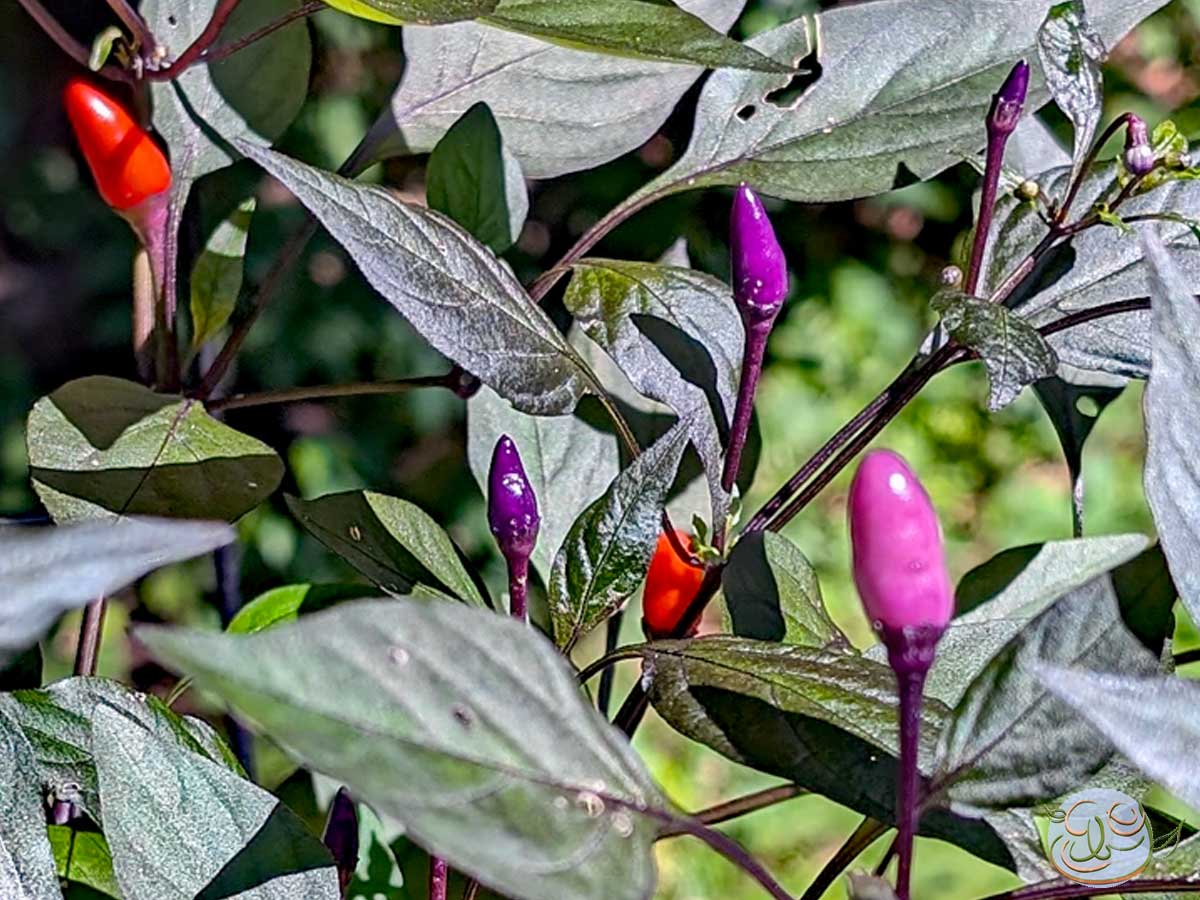

When we attended the Washington Gardener’s Magazine’s seed swap earlier this spring, I had no idea I would be bringing back a pepper plant that would add such vibrance and joy to our garden. Of course, all seed swaps have their potential for surprising new additions to your garden. The Grandma Kirksey pepper was just such a gem for us. The Grandma Kirksey pepper has proven itself to be not just ornamental and a joy to watch grow, but also has culinary uses in the kitchen. With beautiful purple-tinted leaves and fruit that changes color, this ornamental pepper is not only gorgeous but easy to grow too! Plant it, then sit back to enjoy the show!
Even Grandma Kirksey (& The Pepper Plant) Was Young Once

Grandma Kirksey peppers come almost exclusively from Seed Savers Exchange, a network of gardeners interested in preserving heirloom varieties and bolstering biodiversity. They say that “‘Grandma Kirksey’ is named for Willie Jane (Pulley) Kirksey, who received the variety during the Great Depression and grew the peppers in her flower beds.” A quick internet search of genealogy sites leads me to believe that she lived in Arkansas from 1903 to 1999. I think she probably would be proud to have such a vibrant pepper carrying her name!
(NOTE: we’re unaffiliated with Seed Savers Exchange, but as they are the primary method that you can pick up seeds of this amazing plant to grow for yourself, I simply must include their link: Get Your Grandma Kirksey Seeds Here.)
Starting Grandma Kirksey’s Seeds
After picking up our packet of Grandma Kirksey pepper seeds from our local seed swap, we elected to start our seeds indoors. [Learn how to start your seeds indoors like a pro!] Like most hot peppers, Grandma Kirksey peppers take awhile to reach maturity. Seed Savers states it takes 100 days. From our experience, however, I’d say it takes far longer. Our 1st mature pepper didn’t come ripe until 160 days after sowing.
Since we had experience with growing hot peppers before [Like our Thomas Jefferson Cayenne Peppers] we based our seed start date on the hours of sunlight that we receive a day. Where I live, we start to receive more than 10 hours of sunlight a day starting January 25th. Thanks to author and gardener Eliot Coleman and his book The Winter Harvest Handbook & Year-Round Vegetable Production (affiliate link), we call these “Persephone Days.” [Learn more about the Persephone Period and how it can help you plan your garden all year round.]
Just to be on the safe side, we waited another month, starting the Grandma Kirksey pepper seeds indoors using the soil blocking method in late February. By Seed Savers’ prediction, this means that we were hoping for peppers by Memorial Day. As mentioned earlier, that didn’t happen. [The soil blocking method, however, was a huge success, which we can’t recommend more highly!]
Letting Grandma Out of the Home

Once Grandma Kirksey’s Pepper plants have secondary leaves, it’s time to let her out of the home. Plant well after the frost has passed. Remember, these are hot peppers. As such, they don’t appreciate any hint of cold weather.
We transferred our pepper plants outside just before Memorial Day – May 25th to be exact. Before transplanting, and for the entire previous week, we made sure to harden them off. [Learn how to transplant plant you start indoors like a pro with our Hardening Off Handbook.]
Caring for Grandma, that is, the Kirksey Pepper
Don’t baby Grandma! Too much fussing will cause Grandma Kirksey to turn the other leaf. These plants are remarkably simple to care for!
Sunlight Requirements
Like all plants with purple leaves, Grandma Kirksey pepper plants enjoy full sun and will turn more green if not receiving their daily requirement of sunlight. Even if placed in a location that is shaded for some of the day, Kirksey pepper plants will thrive as long as they receive at least 6 hours of sunlight a day.
Water Requirements
Before plants produce fruit, watering once a day is usually sufficient. However, once the plant is fruiting, watering both in the morning and in the late afternoon to early evening will ensure full and flavorful fruit.
Purple Petals, Fiery Future

If “maturity” on the pepper packet means when the plant begins to produce flower blossoms, then we will acknowledge that’s probably correct. 100 days after planting seeds, Grandma Kirksey will start setting pepper blossoms. Blossoms appear as all peppers do: from a branching location between two or more branching stems.

Blossoms emerge with lowered heads and remain that way as it matures to a flower. Flowers are a soft but deep hue of purple that matches the underlying purple of the plants’ leaves — and, later, the color of its magical fruit.
Once pollinated, Grandma Kirksey’s peppers stand up to be counted. This is different than other pepper plants, where the blossom never raises its head when mature. The nature of these blossoms sets aside peppers considered “ornamental” from those considered merely edible.
Fruit, when if forms, remains upright, like the mature blossom.

Like Grandma, Full of Surprises: The Color-Changing Kirksey Pepper
One of the reasons we decided to give Grandma Kirksey a shot is the color-changing nature of the pepper. As the pepper matures, it undergoes a series of brilliant color metamorphoses that delight the eye and make for a stunning display in any garden – ornamental or vegetable.
Pretty in Purple, Grandma’s First Dance

When fruit first emerges, Grandma Kirkey’s pepper is a vibrant, violet hue. This stage of the pepper lasts a long while. You can expect a single pepper to stay a beautiful purple hue for upwards of a month.
Grandma’s Sunny Stage

As the pepper matures, the vibrant violet color begins to fade. Eventually, about 2 months after the blossom emerges and becomes pollinated, the purple pepper ripens, shifting to a pale yellow color. Almost translucent in the sunlight, you can see the beginnings of the vibrant color it will soon display.
Grandma’s Golden Years

By a week to a week and a half later, the pale yellow pepper will become a bright, fiery orange color. At this stage, the plant as a whole should have multiple peppers in various stages of maturity. By late summer, Grandma Kirksey shows her full colors! Peppers of purple, yellow and orange appear on almost every branch.
The Red Hat Society

Glorious and unrepentant of being a beautiful orange color, 10 to 15 days later, Grandma Kirksey reaches her full stage of pepper maturity with a bright red color. At this point, the fruit is full and fleshy, ideal for tacos or processing for hot sauce – if you have enough peppers. This is the stage the Kirksey pepper should be harvested for maximum flavor.
Grandma’s Wrinkled Wisdom

Alas! All good things must come to an end. If left on the bush, about 15 to 20 days after vibrantly showing off, the pepper will begin to wrinkle. Now is the time to harvest if you’re looking for hot pepper flakes and seeds.
Grandma’s Hot Garden Secret
Nearly all ornamental peppers are hot peppers. The Grandma Kirksey pepper is no exception. These peppers are somewhere between the milder cayenne pepper and the much harsher alkali hot of the habanero pepper. [Wow! If you love hot peppers like we do, check out how to grow and produce a bumper crop of habanero peppers!]
Like all peppers, the heat is in the inner lining and the seeds. It’s best to cut the seeds away to save them for future plantings. But Grandma Kirksey peppers are more than just ornamental! If you have enough of them that are ripe at the same time, use them as hot sauce or fresh in tacos or taco salads. Left to ripen and wrinkle, they make excellent hot pepper flakes for a greater heat than cayennes.
Conclusion
You don’t have to love hot foods to cultivate the Grandma Kirksey pepper. After all, Grandma Kirksey herself grew these peppers in her flower bed! They can be admired for their stunning color shifts or enjoyed for their spicy kick. Just like a cherished grandma, these pepper remind us that the best things in life only get better with time.