
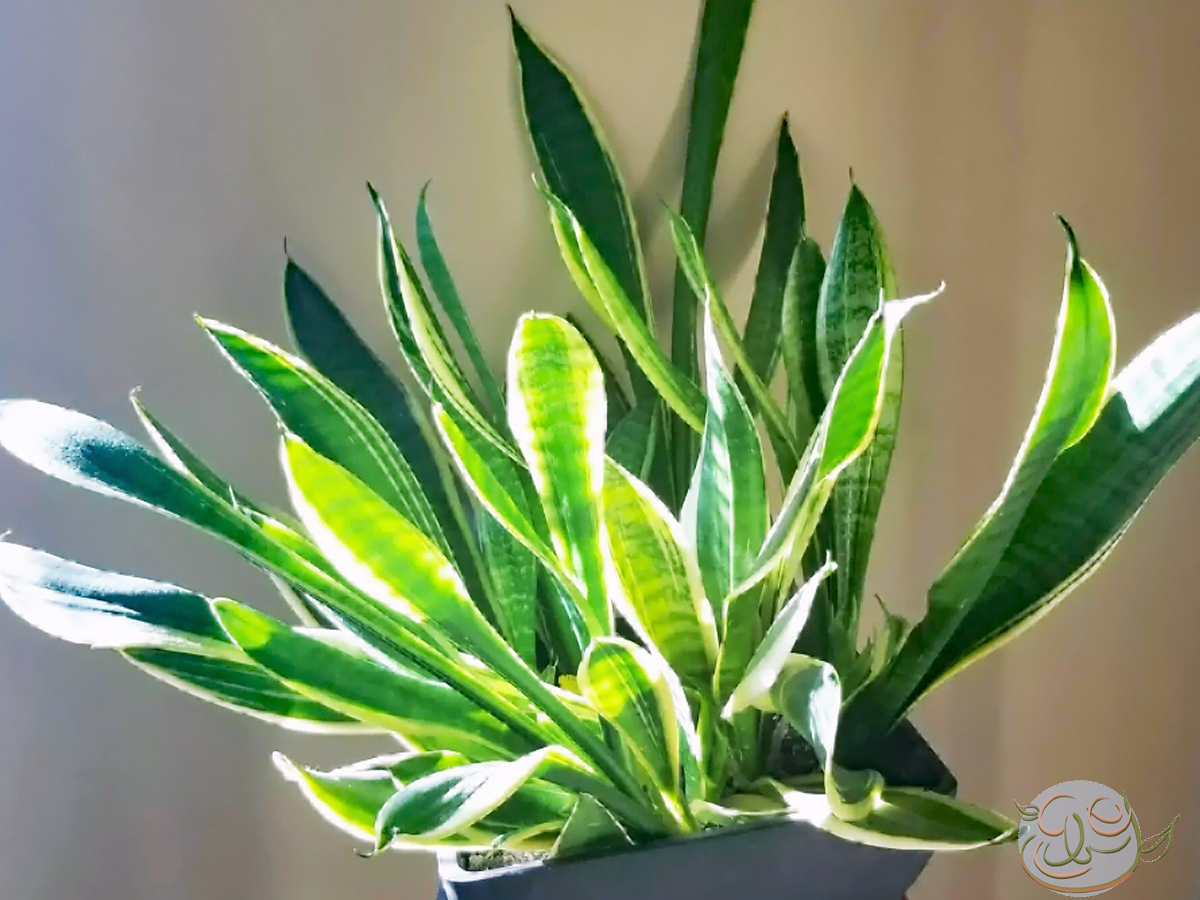
Looking for the perfect beginner plant for yourself or someone else? A Snake Plant is at the top of my list. In America and other countries, when someone moves into a new home, it is customary to gift a housewarming plant. Typically, this happens when the person who has just moved hosts a party, dinner, or other social event. In my case, it was a Halloween party in 2009 that my best friend and I hosted for our office co-workers. At the party, my fellow data analyst Judith presented me with a Sansevieria trafasciata laurentii. It has been one of the best housewarming gifts I have ever received. Neither of us knew at the time that she was not just giving me a housewarming present, but a life-long passion for gardening.
Despite growing up in a quasi-homesteading family, I had previously never thought of myself as much of a gardener. I had killed cacti (no joke!). Although I graciously accepted this plant as a housewarming gift, at the time, I was pretty sure that I was going to kill it. My poor victim — I mean, houseplant — was about 6 inches tall in a pot with no drainage, surrounded by a small, five-pointed ivy which acted as a groundcover around it. The Ivy later died, but the Sansevieria remained. This thoughtful housewarming plant rekindled a love of growing things in my life.
A Snake Plant Has Many Names
This plant, native to Africa, has many names including but certainly not limited to: Mother-in-Law’s Tongue, Devil’s Tongue, Jinn’s Tongue, Snake Tongue, and Saint George’s Sword. Each of its many monikers clearly take into account the presentation of the leaves. A Sansevieria’s sharp, tall leaves rise out of the pot with patterned foliage likened to that of a snake’s scales. Another of it’s names is the Viper’s Bowstring Hemp. When stripped of the pulp, the plant fibers can be used to create ropes, strings, even fabric. (I might have to give this a try.)
With the advent of molecular phylogenetics (which analyzes plants based on their molecular structure), scientists reassigned the Sansevieria to the genus Dracaena. The Dracaena genus contains a veritable mountain of plant varieties. At Eastborn Gardens, I currently have three of such Dracaena plant types [including the Dracaena marginata or Dragon Tree]. The Snake Plant is but one of many Dracaena varieties. As a result of the molecular analysis, this plant’s scientific name changed from Sansevieria trifasciata to Dracaena trifasciata in 2015. The “trifasciata” part of its scientific name refers to the way its leaves bundle in a rosette of three bundles. Despite the scientific reclassification, it is still common enough today to refer to this plant by its old name, and its common names persist.
Best Locations for a Snake Plant Indoors

If you ever pay attention to the plants in a mall, or office, or high-end hotel, you will probably recognize snake plants. This is because this plant is extremely forgiving, requiring very little care. It can survive and thrive in nearly any level of light and is tolerant of infrequent watering. As such, the Sansevieria is a perfect plant for beginner gardeners.
Though originally a desert plant, it performs very well in low light conditions. It can spruce up any shadowed corner away from windows. Snake plants in the bedroom are a particularly great idea as the Sansevieria plant benefits you as you sleep. During the day, the leaves close their pores to protect itself from drying out in hot desert sun. At night, it opens them, releasing stored oxygen and taking on new carbon dioxide. As a result, it can marginally purify the air in your bedroom while you sleep.
A word of warning, however! You should keep pets away from this plant as snake plants are harmful to both cats and dogs if ingested.
Propagating Snake Plants

Snake Plants don’t have deep roots and sustain themselves naturally in shallow planters. New plants spring from underground rhizome root nodes to fill all corners of the pot with any remaining space.
You can propagate Sansevierias by cutting the rhizome and separating the individual plants into different pots.
You can also propagate the snake plant in water from leaf cuttings. Cut a leaf near the base of the existing plant. Set in a dry place to allow the cutting to dry and scab over for a couple days. Then, place the Sansevieria plants in water enough to cover the scabbed over base. Be patient! New roots can take up to two months to begin to form at the base of the cutting. Once the roots have established, you can pot the new plant in a soil and planter with high drainage.

Beware! When you propagate a snake plant by cuttings, new plants that emerge will lose some of the unique patterns its parent plant may possess like gold edges or mottled green foliage. New Sansevieria plants propagated by cuttings will generally be solid in color.
Indoor Snake Plant Care
Correctly determining the amount of water a plant need is the most difficult part of caring for houseplants. Snake plants are no exception to this rule. Underwatering is always a danger, but the opposite is also true. Overwatering is particularly hazardous to a Snake Plant’s growth and can kill it far more readily than underwatering.
The Dangers (and Benefit) of Underwatering
Snake plants flower in their natural environment, but rarely indoors. I have only been able to get mine to flower once. I’m embarrassed to admit that I was cruel to my snake plant one autumn. I relocated this plant in a sunny window of my home office and completely forgot about it. At the time, I was still working in an office building and rarely used my home office. So I failed to water the snake plant for nearly three months! When seeking a pleasant houseplant for a lower-light location in our newly re-designed reading nook, I decided to settle on some snake plant décor and went to retrieve it. I discovered that my Sansevieria had sent up a flower stalk, which had once born small, white flowers.

Having gone so long without care, he flowers, alas, were dried and dead at this point. The once plump leaves were shriveled, thin and brittle. A brown spot on one of the leaves indicated that it had been in too-direct sunlight. One of the leaves, the largest of them, had fallen over, bending itself almost in half. Oops!
I brought the plant into our new reading nook. There, I would remember to tend it and proceeded to water it. Not only did some diligent care fill out its thin leaves, the leaf that had fallen eventually healed itself! It wasn’t long before the Snake Plant was once again standing straight up as it had before.
Overwatering a Snake Plant is Catastrophic
Overwatering causes more snake plant problems than underwatering. As a desert plant, giving a snake plant too much water will cause the roots to rot. The leaves will fall over in a spongy mess. If placed in a darker corner that doesn’t receive much light, cut back your watering to only once or twice a month.
Root rot becomes apparent when the base of the leaves begin to show brown and bloated. This travels upward through the leaf until the entire frond falls over and withers in an unattractive brown mush. Root rot must be addressed at the source — the “root” of the problem, if you will (sorry, I couldn’t resist!). You must repot the plant in a lighter soil mixture designed for greater drainage. A Sansevieria’s planter should also have large holes in the bottom to release excess moisture. Cut away any spongy roots and repot the unaffected portion of your plant. This will optimize your chances of saving your plant.
Unfortunately, you cannot save any leaves already affected by root rot. Any attempt to make cuttings from damaged leaves will only result in the rest of the leaf’s decay. I wish I could say that I didn’t know this from experience, but alas, I have witnessed this first-hand. I am relieved to report that I did save the mother plant. Still, it was a long, worrying couple of months before I was sure the plant was out of harm’s way. Learn from my mistakes, friends!
Conclusion
Happily, Sanseviera plants are perennials and live for decades. Despite many (mis)adventures, the housewarming gift from that fateful Halloween has already lived more than 13 years in my care. My beloved plant which kickstarted my love of growing things will be with me for many more years to come!

Related Reading
Looking for other easy, beginner plants? From bold foliage to vibrant flowers, plants are instant additions to home design and many are simple to care for. Check out this post for some more Easy Ornamental Houseplants for a glimpse at some of my favorites.


6 responses to “The Best Housewarming Plant Ever: Snake Plant (Dracaena (Sansevieria) Trifasciata Laurentii)”
[…] about once or twice a year or it will cease flowering. Earlier this year, I divided my pot-bound Sansevieria (Snake Plant) and one of the smaller sections separated from the root base by accident. When my husband and I […]
[…] your plant? Get one that doesn’t need water very often. Desert plants like cacti and snake plants make hearty friends for decades and only require water every other week or so. Some plants (like […]
[…] Dracaena (pronounced drah-SEE-nah) is a genus within the family Asparagaceae. Yes, the very same family that gives us our tasty garden asparagus. Dracaenas are also closely related to the Sansevieria which we also grow here at Eastborn Gardens. You can read about Sansevierias further in my blog post: The Best Housewarming Gift Ever: Snake Plant (Sansevieria (Dracaena) Trifasciata Laurentii). […]
[…] There are some tips and tricks I’ve learned about caring for Snake Plants along the way. Head on over to this dedicated Snake Plant post to learn more. […]
[…] Because these plant boxes will be on top of your moving boxes, you can also tape up the box sides and leave the top open. This is a good option if your plant doesn’t quite fit or is especially rigid like a snake plant. […]
[…] pores are easier to get to and bite into. Tropical plants like prayer plants (Maranta leuconeura), snake plants (Dracaena (Sansevieria) Trifasciata), and Anthuriums (Anthurium andraeanum) are less susceptible to whiteflies due to the waxy-like […]