
It’s that time of year again! The cold weather outside continues to drop below freezing each night. Most of the still-bare trees haven’t even thought about sending out buds yet. The raised beds on the porch where we planted our tomatoes last year are partly frozen. Earlier this week, we even had snow here where I live (and I know that’s been true of the northern part of the United States for months)! No matter what Punxsutawney Phil says, I can think of no better time than the last week of January and the first week of February to start planning the garden for the spring growing season!
At first, planning the garden feels like a daunting task. Whatever choices you make now, you’ll have to live with for the rest of the year. If you’re planting edibles, the plants you choose now will become a large part of yours and your family’s diet for the season. Where you decide to plant your chosen vegetables, herbs, and flowers will make a big difference in how they grow and perform over the next several months. It’s a lot to consider and the planting season will come sooner than you know it.
There are a few steps that I perform each year during this planning period to take the pressure off me, and to add a little creativity to the process. This 5 step guide walks you through the What, Where, and Why to make this process easy.
Garden Planning Step 1: Wins and Sins, Reflecting on Last Year
Step one begins the previous autumn at the close of the gardening season, but you can do it in the spring too. It is an account of each type of plant, what worked and what didn’t, what surprises arose and how those surprises can be better handled if they happen again.
In the spring, I refer to this account to make sure we continue the wins and do not repeat the sins. This autumn narrative is so detailed that it deserves a post all on its own. Basically, note out what went well, what went poorly, and what you want to do better at this year.
Garden Planning Step 2: Decide What to Plant
This is the fun part. What gardener doesn’t love paging through seed catalogues, online or otherwise? Seed catalogues are toy catalogues for gardeners! Here, you get to decide what plants you’re going to grow this season. I like to try a mix of established favorites and at least one new experiment.
This step is my favorite! It’s brimming with possibilities and the anticipation of the upcoming growing season!
Gardening Planning Step 3: Decide Where to Plant
Where you live (urban, suburban, or country), may determine this for you. I have largely been a container gardener out of necessity. Small lawns with pre-described HOA landscaping really throw a damper on a homesteader’s ambition. In our small, urban townhouse, we don’t have much space for dedicated planting. However, we do have a decently-sized back deck where we gardened last year and we plan to make great use of it.
Here it is, ready for the planting season (We may be planning our garden already, but earlier this week the raised beds and containers were covered with what ended up being the first snow we’ve received all Winter):

When planning where to plant, I divide my planning by indoors and outdoors. My indoor containers are largely kitchen herbs, while the outdoor raised beds and pots are largely vegetables and fruits. Even if you’re planning a container garden (like me), it helps to take a moment to plan this out. Certain plants are compatible or incompatible with others, which can boost or stifle growth. Peas, for example love mint, but hate onions. Do some research on companion planting to know who likes and doesn’t like who and keep this in mind when planting in raised beds or near one another in ground.
Gardening Planning Step 4: Decide When to Plant
This year, the when part of this question facilitated the launch of this blog. It was the kick in the plants I needed! (Pun intended, you can thank my husband.) This question is also unique for me this year since, as mentioned above, my husband and I moved with our plants last year to a new growing zone. We weren’t here in northern Virginia for the spring planting season, and we planted very late for our area (last week in May!).
This year, I’m checking the online Farmer’s Almanac for my new-to-me USDA Growing Zone 7a (we moved from 5b, so it’s a jump). If you’re in the US and you don’t know your growing zone, you can also find the USDA Plant Hardiness Zone Map online. HINT! In November 2023, the USDA just updated their Plant Hardiness Zone Map for the first time since 2012.
To really get that jump-start on the 2023 growing season, we are planning to start our seeds indoors. If you’re planning on sowing from seed outdoors, you may plan a little differently to wait until after the last frost. Here, again, the Farmer’s Almanac for your area can assist.
Step 5: Revisit Steps 2-4 to Know What You Need
5.1 What You Need to Make What Successful
Are you planting from seeds or do you need to purchase seedlings? Do you have seeds saved from previous years or do you need to purchase some? Normally, I’d be ordering my seeds (or have already ordered them) from my favorite seed catalogues. But since I have been saving seeds for years, I have (almost) everything I need in my seed storage container. Going through the seeds I’ve saved also helps me decide what to plant (and curbs any tendency to over-buy).

Also, take a close look at the supplies you’ll need. Do you have tools needing maintenance like rusty garden spades or dull pruning sheers? There are several ways to take care of rusty tools, but they do take effort. Make a note and schedule a time to take care of those chores before you will need those tools.
Certain kinds of plants need different tools to be successful. Plants like tomatoes, vining beans, or peas will need trellises to climb and support them. It’s best to have these ready for to go, or even already installed earlier rather than later. Give your plants their best start by thinking through these questions in advance.
5.2 What You Need to Make Where successful
Think about where you’ve planned to grow your garden. If you’re planning a container garden or raised beds, think about your containers as supplies too. Do you have enough pots for everything you’re going to plant? Are your raised beds or pots in good condition or do they need maintenance after the winter chill? Now’s the time to check.
Regardless of whether you’re planting in ground or in pots, think about the soil you’re planting in. Are you reusing garden plots from last year? What was planted there last year? What nutrients do this year’s plants need? For example, I know that my tomatoes will need lots of calcium in the soil to stop the blossom rot that happened a few years ago, so I’m planning accordingly. Make sure to fertilize your soil or mix in compost to give it the nutrients your plants will need to grow big and strong. [Eggshells are a great way to deliver calcium to your soil. Learn all about it in this article.]
Step 5.3 What You Need to Make When Successful
Are you planting outdoors? Do you have what you need for a late season frost? Depending on where you live, if the weather decides to be tricky late this spring and throws a freak frosty evening after you’ve planted outdoors, you may want to be prepared with a frost cover or floating row covers to cover your plants. (I’ve been known to make my own frost covers). It may be counterintuitive, but if you plan your garden for failure, you’ll be ready and your garden can succeed even if the worst happens.
Are you planting indoors first? Then you’ll need seed trays and seed starter. You’ve planned what you’re planting, so you know exactly how many seed compartments you’ll need to start your plants off well.
If you decided to start your garden from established plants rather than seeds, you’ll need to keep in mind when you’re going to pick these up, or when the company you ordered from will ship them to you. This detail will make all the difference to your garden. Young plants don’t like to sit in the flimsy plastic pots nurseries ship them in. You’ll want to transplant them into your garden shortly after you receive them and as soon as they’ll be safe from frost.
Make Your Plan Pretty
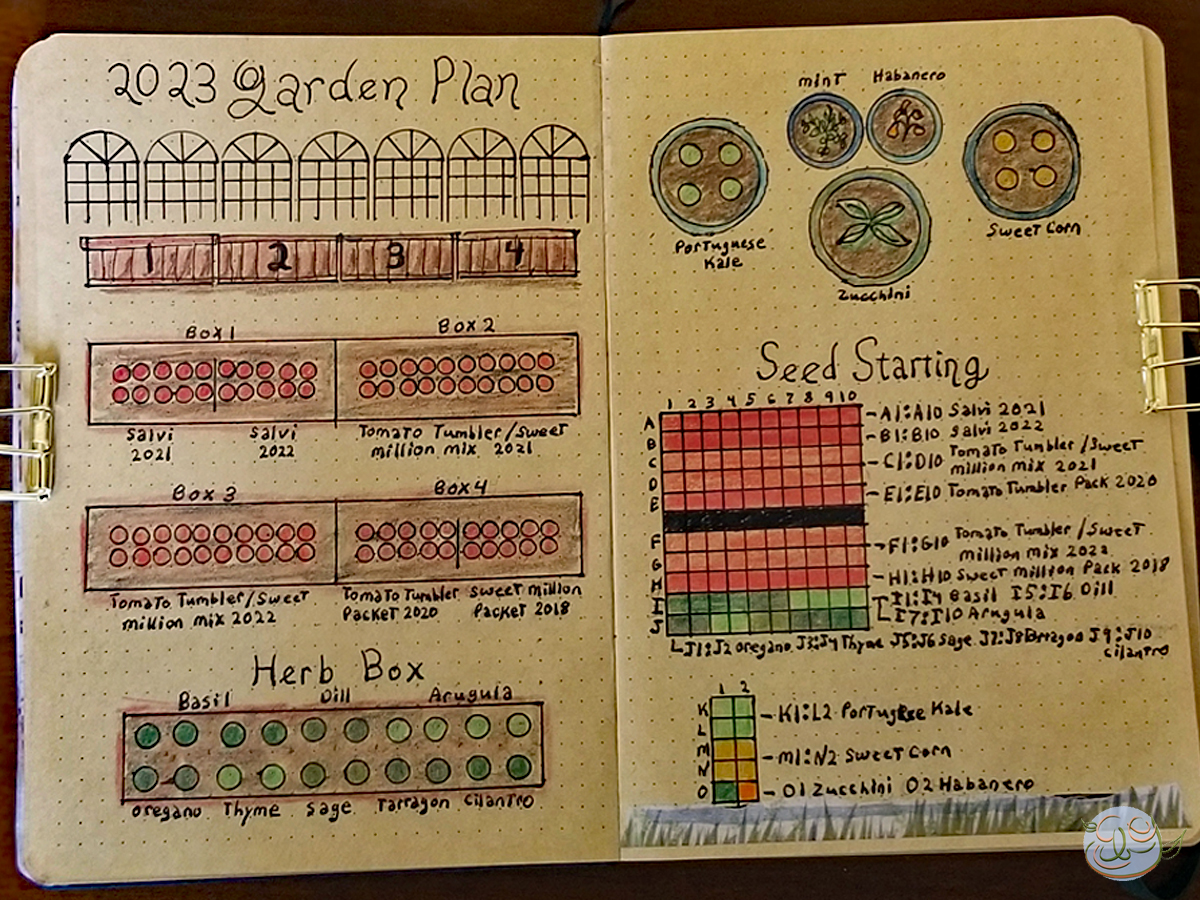
Who says your garden plan has to be dull and boring? I am a huge planner both through electronic and paper means. I keep a dedicated bullet journal to document basic tasks and to-dos, including what gets planted where so I never forget or get confused. As a seed-saver, I’m also documenting how different varieties (and different years) of plants perform from seeds saved over years.
This year, I’ve documented my plan for the indoor and outdoor garden in my A5 Archer and Olive Craft Paper Dot Grid notebook (completely unaffiliated, but I love this planner!). I must say that I’m very pleased with how it has turned out!
In my Garden Plan sketch, I have a section for seed starting, too. In my journal, I’ve already planned out my seed trays. When I start my plants from seed indoors, I want to make sure I know which plant they are so I can transplant them properly according to my plan. This level of detail is certainly not required! You can use popsicle sticks or other in-soil markers for this too. Some seed starter trays even come with markers to make this easy for you.
Conclusion
So, to recap, The 5 Step No Fail Process to plan your garden:
- Reflect on Last Year’s Wins and Sins: What went well? What went poorly? What can I do differently?
- Decide What to Plant: Seeds or seedlings? Old favorites, something new, or a mix?
- Decide Where to Plant: Indoors, outdoors, or both? Which plants might like or dislike certain neighbor plants?
- Decide When to Plant: When does the last spring frost typically fall in my garden’s growing zone – how can I plan for that? If planting from established plants, when will I have my seedlings?
- 4.5: Decide How to Plant: Direct Sow? Start indoors? Seed Trays? Soil Blocking? Biodegradable pots? Egg cartons?
- Revisit Steps 2-4 to Decide What You Need For Each Step:
- What do I need to buy? Have I saved seeds? Do I need to purchase soil for pots or raised beds?
- Do my tools or raised beds need maintenance? Does my soil need fertilizer?
- Do I need seed trays to start indoors? What about frost covers to protect young plants from potential late frosts?
What are you going to plant this year? And how do you keep it all straight?
I’ll be sharing progress reports on my own garden plan — and the garden itself — in upcoming posts throughout the entire year!



4 responses to “Garden Planning for the Spring Growing Season”
[…] you made a garden plan in the spring, now’s the time to pull it out again. It can help to remember how you started the year. […]
[…] in review. (If you want to know how to perform your own Spring Garden Plan, look no further than Garden Planning for the Spring Growing Season.) It’s helpful to have my spring plan with me as a reference. I also keep a photo log of my […]
[…] spring, I follow my 5 Step No Fail Process to Plan My Garden. This year is no different. It’s a series of questions that I ask myself each spring when […]
[…] area or container garden will leach calcium from the soil faster than usual. If you have the space, plan your garden to give enough space between plants. Space between plants can help to mitigate leaching the soil […]