
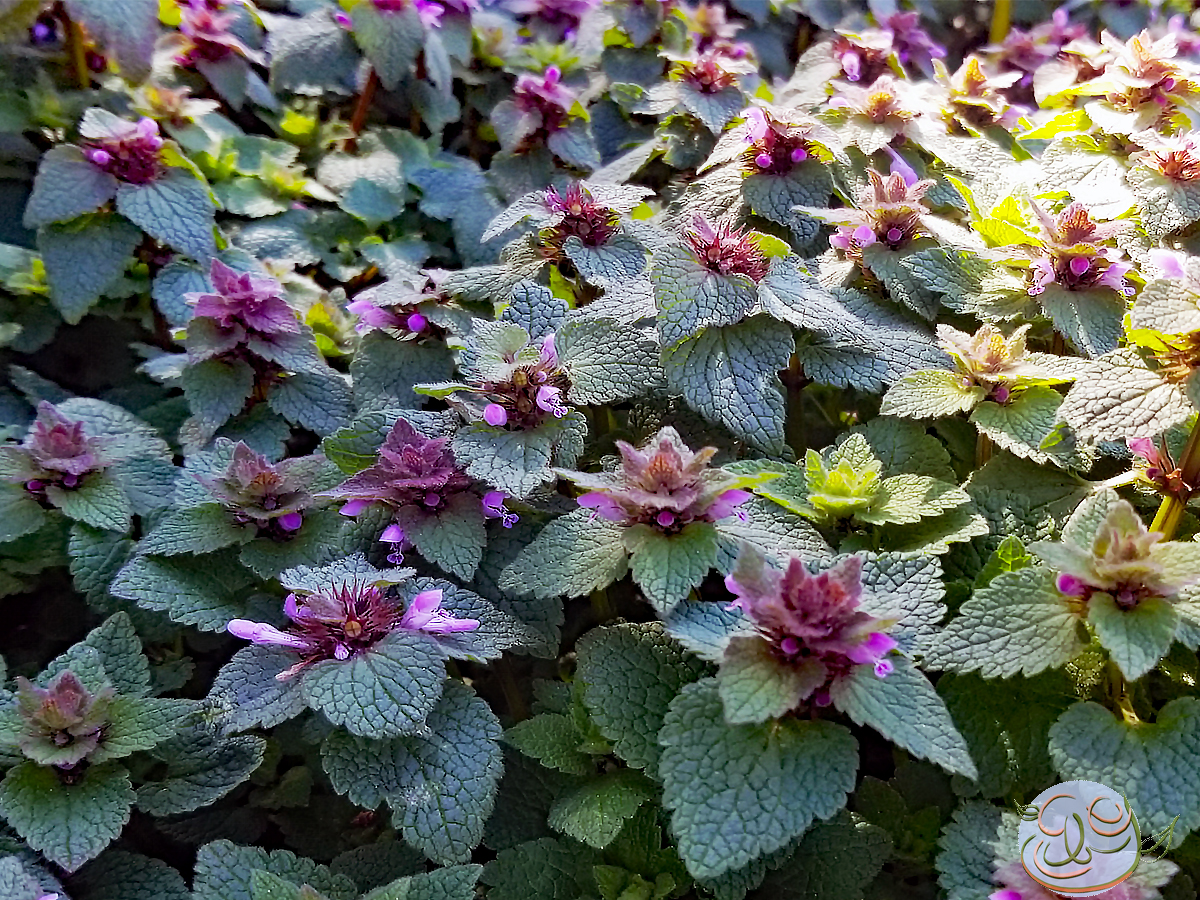
When I’m not gardening, I spend many weekly hours on local running and biking trails. These trails take me alongside highways and through wooded public land. To keep my mind occupied, I play a sort of I-Spy game. My runs become a chance to look around at my environment, and even occasionally forage for wild edibles. A couple weeks ago, I spotted a dense undergrowth of plants, clearly wild, with tiny purple blossoms. I had no idea what I was looking at. I took some pictures, snipped a couple branches, and brought my specimens back home to research. My local gardeners were helpful to quickly provide the answer with a well-timed Instagram post about local plants to forage, citing Dead Nettle (Lamium) as one of them. So, I set out to learn what I could of the Dead Nettle (also written Deadnettle, or even occasionally Dead-Nettle).
As I discovered while on my run around my neighborhood, Dead Nettles grow in disturbed soil such as beside roads and paved running pathways. It is a common ground cover in shade gardens, but can quickly get out of control. In northern climates or in the early spring when the sunlight isn’t as direct, it also grows in full sunlight.
When I showed my husband the specimen I’d brought home, he immediately equated it with mint. An extremely informed observation as the Dead Nettle, like mint, is a member of the family Lamiaceae. Also like mint, Dead Nettles spread underground through rhizomes. This makes it very difficult to eliminate from lawns and yards.
Types of Lamium
The genus Lamium contains about 30 different species. The kind of Lamium I brought home was the Purple Dead Nettle (Lamium purpureum). This species is an annual. It is known for its purple flowers and gentle purple tint of the top leaves. As such, it is also called a Red Nettle or the Purple Archangel, but the scientific name is the same. In areas where it provides a thick ground cover, the plant gives a distinctive purple hue over the ground. This is especially true where viewed at a distance.

Other common varieties of Lamiums include: Spotted Dead Nettle (Lamium maculatum) and White Dead Nettle (Lamium album) both of which are perennials. All varieties of Lamiums native to Europe, and so considered invasive in the United States. The Global Register of Introduced and Invasive Species (GRIIS) is my favorite for information on invasive plants in my area.
Why is it called Dead Nettle?
The serrated leaves of a Dead Nettle resemble those of the Stinging Nettle (also called the Common Nettle). However, the two plants are completely unrelated. Stinging Nettles come from the family Urticaceae and Dead Nettles from the family Lamiaceae. Unlike the Stinging Nettle, Dead Nettles do not have the long hairs containing a chemical irritant that can create rashes on human skin. Lamiums are called “dead” nettles because they are harmless. In fact, Dead Nettles are edible to humans and have many uses.
Dead Nettle Uses
Dead Nettles are medicinal herbs in that the leaves are an astringent with anti-inflammatory and anti-fungal properties. As such, herbalists often cite it as a useful herb for cuts and and mild wounds. Tea companies often sell nettle tea as a useful medicinal tincture for allergies or mild aches and pains.
You can also eat dead nettle raw as part of a salad or cooked in dishes like spinach. As is the case with most leafy plants, the younger leaves will be sweeter than the older leaves. Unlike its family member mint, it has a very mild flavor that is almost unnoticeable. So it’s best partnered with other more fragrant leafy greens.
Bees and Butterflies love all kinds of Dead Nettles and will flock to their tiny, tube-shaped flowers. Lamiums are one of the first ground cover flowers to emerge. So, despite being invasive in the United States, early-emerging insects will find early spring food in the prolific spread of dead nettles.

Dead Nettle Plant Propagation
There are several ways that Lamiums propagate, either naturally or with assistance.
Seeds
After I got home from my run with my Dead Nettle cuttings, I placed them in a small jar of water to preserve them. A few days later, the plant began to drop seeds all around it. Clearly, my cutting had already been pollinated in the wild. Dead Nettles spread seeds up to a foot away from the parent plant. Dropped seeds require cold stratification to germinate. Seeds dropped in the wild will generally lay dormant for the first year and begin to grow only after a period of cold that’s at least 10 weeks long. Lamium seeds are very small, only about 2 millimeters long by 1.5 millimeters wide and mostly flat.

Cuttings or Layering

Lamiums can spread through cuttings, too. In the wild, this occurs most often when the stems of the plant are near the soil. Stems that are in contact with wet soil where the leaves typically branch (called leaf nodes) can produce roots naturally. When this happens naturally, without severing the stem first, this process is called layering.
You can also take cuttings of a parent plant yourself by cutting the stem just below the leaf nodes. Then, place the cutting into a jar of water or moist soil that the stem stays sufficiently wet. This will begin the rooting process. The process of rooting cuttings in water also works with a lot of other plants.
Dividing
As mentioned earlier, plants in the Lamium family have rhizomes and so are extremely easy to divide. Rhizomes run beneath the surface of the soil and can quickly produce new plants from below. When dividing Lamiums, dig down to the horizontal root base of the rhizome and split separate plants apart from there. Then, you can relocate the liberated plant to your desired location.
Conclusion
All this just goes to show the wonders that Mother Nature can provide. You just have to be willing to look around at your environment with a little curiosity. I never knew I’d come back from a run having foraged such a useful plant. If you’ve tried any recipes or teas using Dead Nettle, leave a note in the comments or get in touch with me @EastbornGardens on Instagram. I’m likely to try foraging more of this plant and making something useful out of it in future.

Related Reading
There’s a whole host of plants out there in the world. If you’re interested in wild plants (especially if they’re edible!), check out these posts on Clover and Garlic Mustard for more facts on those wild plants.


2 responses to “The Edible Nettle: Dead Nettle (Lamium)”
[…] interested in wild plants (especially if they’re edible!), check out these posts on Purple Dead Nettle and Garlic Mustard for more facts on those wild […]
[…] If you want to learn more about edible wild plants found in your own back yard, check out my other posts about the common White Clover and the Purple Dead Nettle. […]