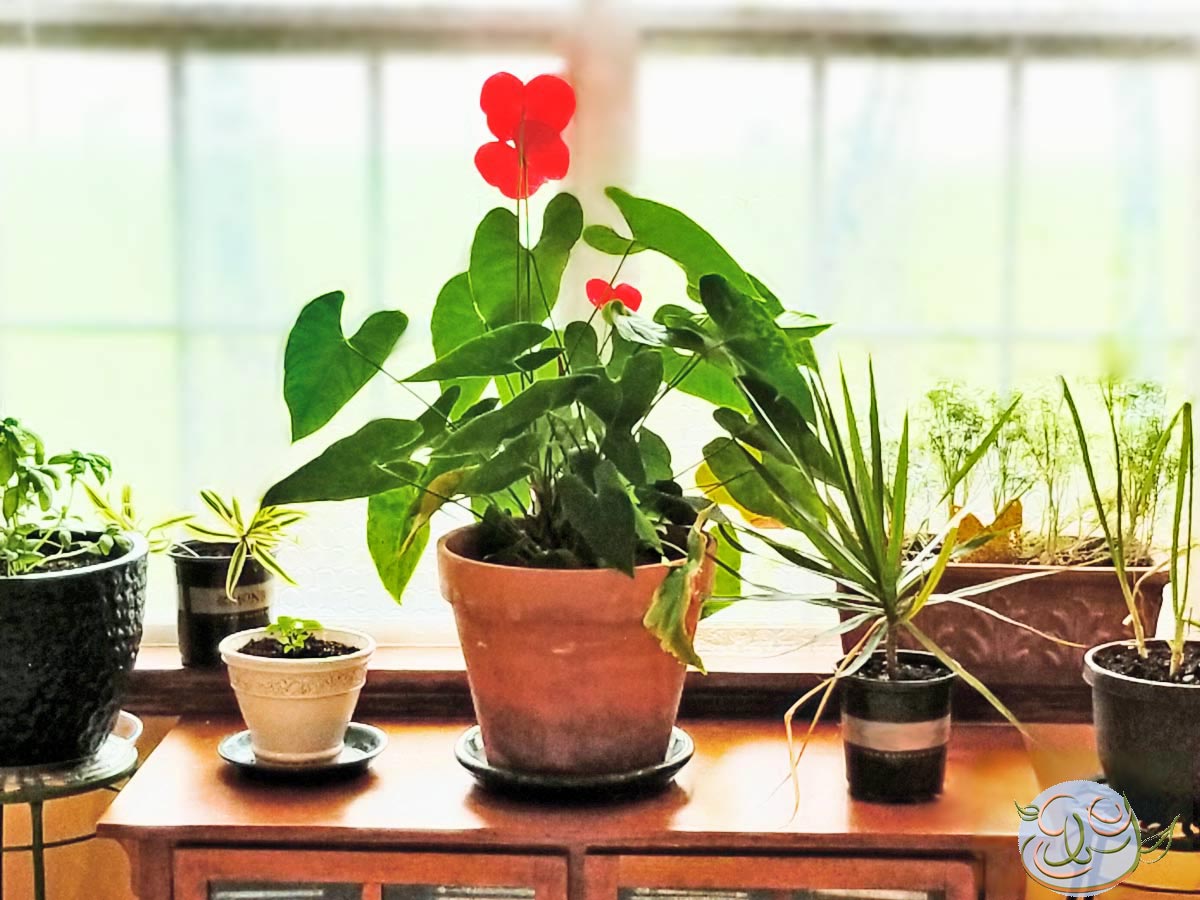
I find solace in my indoor ornamental plants. Although I nurture my indoor plants all year round, come the winter, I have time to focus on them. In winter, they get a little more TLC than they do in the summer months. I choose my houseplants for how easy they are to care for. That way, when I’m once more toiling in the summer soil outside, the indoor plants don’t need my constant attention.
Here are some of my favorite, easy, low-maintenance plants, perfect for beginner gardeners. These fill my house with joy even as nature takes its annual slumber. These plants are almost impossible to kill, survive in a variety of light conditions, and don’t require much upkeep. Plus, these plants give you clean air during a time when you have shut your windows tight against the cold. Win-win!
Flowering Houseplants
Who doesn’t love a splash of color in the middle of winter? These robust, flowering indoor ornamental plants will add some vibrant joy to any drab winter:
Anthurium andraeanum

- Watering Requirement: Medium
- Light Level: Partial Sun
- Flowering: Yes
Native to Columbia and Ecuador, Anthuriums also bear the name Painter’s Palate, due to their bright heart-shaped leaves or spathes. The most common varieties have bright red spathes, but there are many other varieties with varying colors.
Anthuriums are often quite small, but I’ve been able to grow mine to quite large proportions. They like sunlight and will lean towards the nearest window with a lot of light. However, their leaf tips can become burnt in bright, direct sun.
These bold, indoor houseplants will send up waxy leaves and flower stalks closest to light source. So they can become lopsided if not rotated regularly. As a tropical plant, they enjoy a fair amount of water. But if you forget them for several days, they quickly forgive you. With regular watering, anthuriums will bloom all year round if kept indoors at a comfortable room temperature.
Want to learn more? Check out this post for more about The Romantic Anthurium.
Moth Orchid (Phalaenopsis)

- Watering Requirement: Low
- Light Level: Partial Shade to Partial Sun
- Flowering: Yes
Most orchids you will find in supermarkets or nurseries will be the Moth Orchid. There are so many varieties in different colors (some of which growers dye!) that it can be difficult to know which varieties are related. Still, most Moth Orchids share the distinctive petals and bright patterns.
Large box-stores often force their orchids to bloom so they will look pretty, convincing consumers to buy them. If forced to bloom in this way, it can be difficult to get them to re-flower. However, with the right care, you can persuade Moth Orchids to grow more flower stalks after the initial one dies.
A word of warning: this houseplant is finicky with water levels. In fact, the most common mistake most people make with an orchid is to overwater it. This is why these indoor plants often adorn hotel lobbies where the staff have better things to do. A single ice cube of water placed on its bed of peat soil once a week is often enough. They do best in partial sun to partial shade. Too much light and their large, succulent leaves may lose moisture too quickly.
Prayer Plant (Maranta leucomeura)

- Watering Requirement: Medium
- Light Level: Partial Shade to Partial Sun
- Flowering: Yes
The the Silver Veined Maranta is the most common of the different varieties of veined marantas. Pictured here, however, is my office buddy, a Red Veined Maranta (Maranta leucomeura Erythroneura).
Marantas can get quite large, but sit well in a standard 9 inch pot. This plant likes some partial sunlight, but is content being further away from a window, too. Unlike a lot of indoor plants, a Maranta doesn’t require daily watering. That makes it ok to leave alone if, like me, you don’t work the weekends.
Although known for their striking leaf patterns, I am placing this houseplant under the “Flowering” heading for a reason. If you do give this plant a little extra water, it will flower from spring to autumn with tiny, purple, three-petaled leaves at the end of a stalk. The flowers are extremely ephemeral, lasting only a day, but are such a delight to behold.
My favorite part of this plant is that it doesn’t just sit there looking pretty. Marantas MOVE! Pursuant to its name “Prayer Plant”, this house or office plant will fold its leaves upwards from night through the early morning and lower them throughout the day. Sometimes, one of its leaves becomes trapped under another, and it will shudder and make sound when it frees itself. In these post(?)-pandemic years when I now work from home, I can attest that it’s a great plant for the home office. It moves enough to feel like it’s keeping you company.
There’s so much more to say about the Prayer Plant: Click here for a deep dive on this amazing plant!
Non-Flowering Houseplants
Not all houseplants need to have flowers. Some indoor ornamentals sport beautiful and unique leaves worthy of comment and compliment from any houseguests. These are a few of my favorites:
Snake Plant (Sansevieria trifasciata)

- Watering Requirement: Low
- Light Level: Full Shade to Full Sun
- Flowering: Yes, but rarely
This hardy, easy to care for plant is so common a house and office plant that it would be remiss if I didn’t mention it. King of the “unflowering” houseplants (more on that below), if you look around your world, you will spot this plant everywhere.
This plant only rarely flowers indoors. In fact, it’s difficult to coax flowers from a Snake Plant at all. However, if treated exactly right, in conditions similar to its hot and dry desert ancestry, it will produce small white flowers on a long stem similar to a common Orchid or a Hosta. Because of how uncommon the flowers are, many people only know it for its tri-colored leaves.
Sansevierias don’t have very deep roots, so they can survive in a relatively shallow pot. They also don’t require a lot of water. I once placed this plant in a room I didn’t go into often and forgot about it … for three months. It was a little dried out when I finally remembered it, but it quickly sprung back to its former glory.
A Sansevieria can thrive in any light level. As a desert plant, they do well in full sun, but they also manage quite well in shade, which is why they’re common plants for shopping malls and offices. Its pores close during the day to avoid drying out and open at night to release the stored oxygen. This makes it a perfect plant for the bedroom. It will send out a minor amount of fresh oxygen while you sleep.
There are some tips and tricks I’ve learned about caring for Snake Plants along the way. Head on over to this dedicated Snake Plant post to learn more.
Dragon Tree (Dracaena Marginata)

- Watering Requirement: Medium
- Light Level: Partial to Full Sun
- Flowering: No
Native to Madagascar, the Dragon Tree takes its name from its family name. The Dracaena family has a wide variety of plant types which can look very different from one another. All Dracaenas get their name for their scale-like stems and showy foliage likening them to the mythical dragon.
The Dragon Tree gets quite large (up to ten feet!) and some varieties will branch if trimmed. This further perpetuates its mythical similarities as, like the Greek Hydra, cutting one branch will yield two new branches. You can propagate the plant with these cuttings, which sprout roots from the stems.
This plant loves light. A sunny room next to a window is ideal. However, you should rotate it regularly to avoid its top branches craning for the sunlight in one direction. It is a hardy plant and can go for days or a week without water. Yet it will wilt and the tips of its leaves will brown if left dry too long. [More Dracaena Marginata tips and tricks over here!]
Song of India (Dracaena reflexa)

- Watering Requirement: Medium
- Light Level: Partial to Full Sun
- Flowering: No
Despite its common name, the Song of India is native to Madagascar. Like the aforementioned Dragon Tree, it is also from the family Dracaena. The “reflexa” part of its name refers to the lighter coloring on the edges of its leaves.
You can leave the Song of India alone without water for days to a week. As such, you can also find this indoor plant in well-lit shopping malls or offices. As a smaller houseplant, in potted arrangements with other indoor plants, It often adorns the outside edges of planters paired with taller plants in the center.
Like its cousin the Dragon Tree, it can propagate by cuttings. It can even send up new plants through the soil from underground root notes of its parent plant.
Common Ivy

- Watering Requirement: Low
- Light Level: Partial Shade to Partial Sun
- Flowering: No
An ivy is a delightful indoor plant to have as a houseplant. Home-fashion design trends have made the common ivy a star for its tendrils of heart-shaped leaves and ease of care.
Ivies can pull moisture directly out of the air in humid environments. So it is an excellent plant to have in a bathroom. It sends out long, vines of leaves that can drape about windows or walls with curtain rods or small hooks. With a little creativity, you can add a leafy canopy of crown molding to any room.
This easy to care for houseplant enjoys light but lower-light environments don’t perturb it overmuch. It is susceptible to cold windows in cooler climates, however. So it’s best to keep an ivy from directly touching any outside windows where frost may gather.
Conclusion
There are many plants that can keep the greenery in your life throughout the cold, dreary winter months! Want to see more? Check out this list from the United States’ National Gardening Association posted last summer! Do you have some favorite ornamental houseplants you love? Feel free to share in the comments!