

It’s a hot summer already here on the East Coast with temperatures reaching 100 degrees. But that hasn’t stopped us from exploring the local gardens. The Mid-Atlantic part of the United States is an excellent place to visit gardens, as so many of them are open to the public. Located just east of Washington D.C., the United States National Arboretum is one of the most expansive gardens in the area. There’s so much to visit at the National Arboretum that there’s no way you can properly view all the gardens in a single visit. So on a hot, summer day, we decided to tour the U.S. National Arboretum’s Herb Garden.
Herb Garden, One of Many at the U.S. National Arboretum

13 separate gardens make up the United States National Arboretum, of which the Herb Garden is only one:
- Asian Collections
- Azalea Collections
- Dogwood Collection
- Fern Valley
- Friendship Garden
- Gotelli Conifer Collection
- Holly and Magnolia Collections
- National Bonsai & Penjing Museum
- National Boxwood Collectoin
- National Capitol Columns
- National Herb Garden
- Perennial Collections
- Washington Youth Garden
The entire United States National Arboretum spans 451 acres of land along the Anacostia River. Like so many of the museums in the DC area, there is no cost to visit. The grounds are open to the public from 8:00 a.m. to 5:00 p.m. every day except for December 25th. There are two entrances on each of the roads that make up the arboretum’s north and west borders: Bladensburg Road and New York Avenue. Also, the arboretum is extremely easy to reach by public transportation via the B2 bus line, which connects the U.S. National Arboretum with the Washington Metropolitan Area Transit Authority (WMATA) at the Stadium-Armory metro stop.
What’s an Herb? How the U.S. National Arboretum Defines It
The National Herb Garden defines an ‘herb’ as ‘any plant that is useful to people except those used just for lumber, food, or beauty.’ This means that many plants featured in the National Herb Garden are not what we’d typically consider herbs. Plants included in the National Herb Garden fall into four primary categories (and many fall into more than one category):
- Culinary
- Medicinal
- Industrial
- Fragrance
The Herb Garden Ellipse at the U.S. National Arboretum
The main portion of the herb garden is arranged in an elliptical circle near the entrance to the National Arboretum at R Street. The elliptical path contains 10 separate gardens, each with their own category based on how we use the herbs in question. These are known as the Specialty Gardens.
- Dye Garden
- Dioscorides Garden
- Beverage Garden
- Asian Garden
- Fragrance Garden
- Industrial Garden
- Culinary Garden
- Medicinal Garden
- Native American Garden
- Colonial Garden
Dye Garden

The Dye Garden features plants that can create coloring for natural fibers like wool, cotton, linen, and silk. It’s easy to see why we use flowers to make dyes, but in many cases, other plant parts produce coloring. Flowers, fruits, roots, and leaves can produce certain pigments depending on the plant.
Dyes made from plants require a mordant to fix the color. Depending on the mordant, the fiber may take on a different pigment altogether. The humble marigold (Tagetes sp.), for example, makes not only yellows and oranges but greens as well.

- Range: Tropical and warm America, Africa
- Habit: Annual or perennial
- Family: Aster
While viewing the Dye Garden, it’s fun to guess what color of dye each plant might produce. Some plants, like the yellow cosmos (Cosmos sulphureus), produce vastly different colors than you might expect. You might think that dye created with yellow cosmos would be yellow. Instead, yellow cosmos produce rich rust and deep brick-red hues on wool. In fact, the Aztecs used yellow cosmos as a source of red dye.

- Range: Mexico to Brasil
- Habit: Annual
- Family: Aster
Dioscorides Garden

Dioscorides was a Greek physician who wrote a treatise on herbal remedies, De Materia Medica. The Dioscorides Garden showcases a selection of herbs used in medicine as far back as 60 A.D. Dioscorides could well be considered the father of modern pharmacology. Many of the herbs listed in his treatise are still used in medicines today.
Dioscorides wrote that herbs like oregano and milk thistle could treat poisoning from hemlock or opium. Jerusalem sage (Phlomis fruticosa) could soothe intestines. English ivy (Hedera helix) could treat dysentery or used as a burn ointment. Wood from the olive tree could heal dandruff and skin lesions. While the brine of pickled olives could be used as a mouthwash to strengthen gums and loose teeth.

- Range: Mediterranean, west to Sardinia
- Habit: Perennial
- Family: Mint

- Range: Europe, western Asia, northern Africa
- Habit: Evergreen shrub
- Family: Ginseng
Beverage Garden

Herbs are a common ingredient in a variety of beverages. One of the most obvious ways we enjoy herbs in drinks is as teas. The first herbal tea that comes to mind is probably mint. The National Herb Garden boasts the Blue Balsam Peppermint (Mentha x piperita) as one of many herbs that can be brewed into tea.

- Range: Europe, Africa
- Habitat: perennial
- Family: Mint
But that’s not all herbs are good for. Strawberries (Fragaria x ananasa), for example, can not only be juiced, but they can add color and flavor to lemonades. Likewise, many beverages use strawberry essential oils to flavor sodas or daiquiris.

- Range: Hybrid of North American species
- Habitat: Herbaceous perennial
- Family: Rosacene
Asian Garden

Washington D.C. has a long history of friendship with Japan. So it’s no surprise that the National Herb Garden features an Asian Garden. Asian plants commonly adorn landscaping around houses due to their resilient nature and ease of installment. However, this practice has led to many Asian plants becoming invasive in certain parts of the country as they thrive in an area with fewer of their traditional predators.
One less-invasive Asian plant featured in the National Herb Garden is the Lilly-of-the-Valley (Convallaria majalis). With its beautiful striped leaves, it stands out among the other clusters of Asian plants.

- Range: Europe and Asia
- Habitat: Perennial
- Family: Lily
Fragrance Garden

Another common use for plants is their use as scents. Plants in the Fragrance Garden collection lend their scents to essential oils, candles, pot-pourri, and of course perfumes. At this point in the National Herb Garden tour, it becomes clear that we use herbs for many different kinds of things. Mint and lemon balm, for example, appear in both the Fragrance and Beverage gardens (and later in the Culinary Garden below). Herbs often used in the kitchen like sweet basil (Ocimum basilicum), rosemary (Rosmarinus officialis), and garden thyme (Thymus vulgaris) also lend their scents to soaps, perfumes, and incense.

- Range: Cultivated
- Habit: Annual
- Family: Mint

- Range: Mediterranean
- Habit: Shrub
- Family: Mint
Like all the other collections in the National Herb Garden, plants of varying height contribute to the view. Visiting in the height of summer, the oriental trumpet lilies (Lilium ‘Oriana’) towered above the shorter bushes of herbs in spectacularly showy fashion.

- Range: Asia
- Habit: Bulb, corm, or tuber bearing plant
- Family: Liliacae
Industrial Garden

A fascinating array of plants make up the Industrial Garden collection of the National Herb garden. After visiting the Fragrance Garden, it seems obvious that perfume would be an industrial product worth displaying in the Industrial Garden. But there’s much more to the Industrial Garden than just perfumes.
Per the National Arboretum’s definition of ‘herb’, there are some interesting choices of plants displayed in the Industrial Garden. Beets (Beta vulgaris), for example, are not just food for the table, but also cultivated as a source of pectin for canning jams and jellies and as a source of sugar.

- Range: Cultivated
- Habit: Annual or Perennial
- Family: Goosefoot
True aloe (Aloe vera) makes an appearance in the Industrial Garden for its uses in the cosmetic industry. Aloe vera is a huge business and expected to grow to $3.4 Billion by 2030. In the Industrial Herb Garden, these plants grow in pots sunk into the earth, so it’s likely to assume that aloe plants cannot survive the mid-Atlantic winters and spend the winters indoors.

- Range: Mediterranean region
- Habit: Tender perennial
- Family: Lily
Other plants caught our eye which we hadn’t guessed we’d see in the Industrial Garden, but are obvious in hindsight: upland cotton (Gossypium hirsutum), peanuts (Arachis hypogaea), and coffee (Coffee arabica). Humans have cultivated cotton as a natural fiber for fabrics for centuries, but cotton also provides wax and useful oils as well. Peanuts are a source of food for both their nuts and use as cooking oil, sure, but the plant’s oil is also used in paints and dyes. Coffee, meanwhile, is a multi-billion dollar industry and one that fuels 73% of Americans (including the one writing this article).

- Range: East Africa
- Habitat: Evergreen tree
- Family: Rubiaceae
Culinary Garden

At last we come to the garden that comes to mind first when talking about herbs: the Culinary Garden. Herbs commonly flavor meals in the kitchen. From spicy to savory to sweet, herbs augment food and give their signature flavors to meals. They can be commonplace or regional, imparting a different flavor depending on where the herbs came from.
Many herbs in the Culinary Garden feature in other collections in the National Herb Garden while others are unique to the Culinary Garden. Bright red turmeric (Curcuma longa) stands out amongst sweet marjoram (Origanum majorana), pineapple sage (Salvia elegans), common sage (Salvia officianalis), basil (Ocimum basilicum), rosemary (Rosmarinus officialis), Greek mountain oregano (Origanum vulgare ssp. hirtum), a red bay tree (Persea borbonia), and the largest dill plant (Anethium graveolens) that I have ever seen (standing at over 6 feet tall).

- Range: India
- Habitat: Perennial
- Family: Ginger

- Range: Mexico
- Habitat: Tender Perennial
- Family: Mint

- Range: Probably origin Africa
- Habitat: Annual
- Family: Mint

- Range: Greece, Macedonia, Turkey
- Habitat: Perennial
- Family: Mint

- Range: Mediterranean region and Asia Minor
- Habitat: Perennial
- Family: Mint

- Range: MD to FL, west to TX, and Bahamas
- Habitat: Evergreen Tree
- Family: Laurel

- Range: Southwest Asia
- Habitat: Annual
- Family: Carrot
Medicinal Garden

Although we encountered Dioscorides early in our journey around the National Herb Garden ellipse, his notes in De Materia Medica are not the only basis we have for herbal medicines. The healing properties of plants have long been observed through trial and error as humans learned which plants are helpful and which are harmful. A plaque in the Medicinal Garden is quick to point out that the field of medicine is constantly changing. The information showcased in the Medicinal Garden is a snapshot of the point-in-time that the National Arboretum staff last cultivated the garden signs (currently as of the year 2000).
Some obvious inclusions in the Medicinal Garden are the bread poppy (Papaver somniferum), a variety of opium poppy and feverfew (Tanacetum parthenium)
Native American Garden

The Native American Garden features plants used by the indigenous tribes of North America. The plants in this collection are native to the United States and have been used for centuries by tribes across North America.
The Potawatomi steeped round-lobed hepatica (Hepatica americana) into a tea to cure dizziness. Santo Domingo Ceremonial (Nicotiana rustica) was a tobacco favored by tribes in today’s New Mexico as a remedy for skin rashes, snake and insect bites, as well as prayer. The Meskwaki Indians of Wisconsin used Jacob’s Ladder (Polemonium reptans) to induce vomiting.
Colonial Garden

The last stop on the National Herb Gardens’ Ellipse is the Colonial Garden. This garden features plants that were favored by the United States’ early colonists. Colonists used garden thyme (Thymus vulgaris) to flavor foods, heal earaches, toothaches, and hangovers. Garden sage (Salvia officinalis) was believed to be a cure-all. So, colonists would cook the flowers with sugar to “warm and comfort the brain and nerves.”

- Range: Western Mediterranean region
- Habit: Evergreen Shrub
- Family: Mint
Beyond the U.S. National Arboretum’s Herb Garden Ellipse

In addition to the elliptical path that guides visitors to the U.S. National Arboretum around the cultivated collections of herbs, there is a side path of trellised historical roses, collections of peppers and sages, a garden cultivated to show plants that feature in Greek mythology and the Knot Garden, which features trees that have been trellised, tamed, and cultivated to wind their trunks into knots.
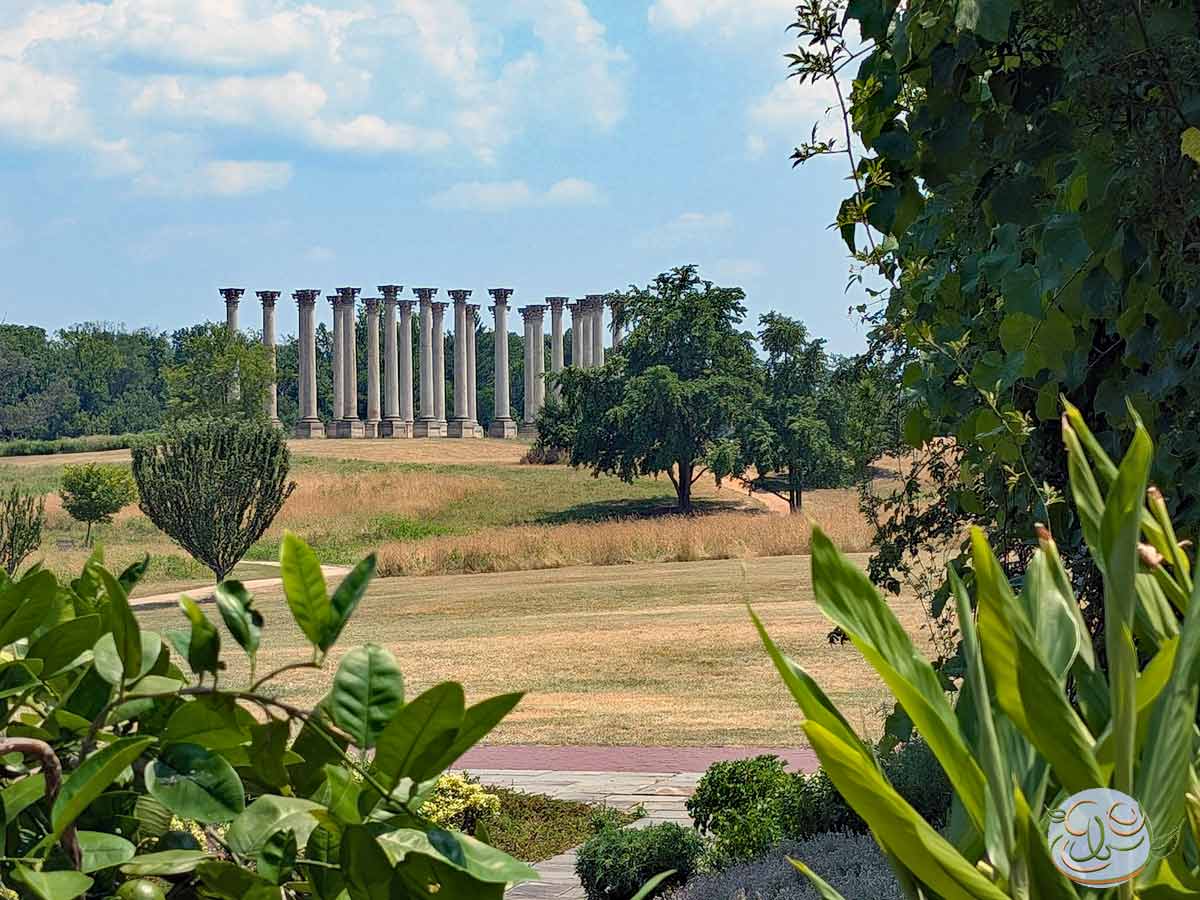
These paths overlook the Capitol Columns which were originally part of the East Portico of the Capitol Building. The columns were later installed at the U.S. National Arboretum following the renovation of the United States Capitol in 1984.
U.S. National Arboretum Herb Garden
There’s so much to see at the United States National Arboretum’s National Herb Garden. More than I could ever cover in this single post. Plus, because gardens are never stationary, there’s always more to see and learn about over time. Different plants come and go as the seasons change so there’s always something new to see!



One response to “Site Visit: National Herb Garden at the U.S. National Arboretum”
[…] [The National Herb Garden at the United States National Arboretum showcases a bunch of different bas… […]