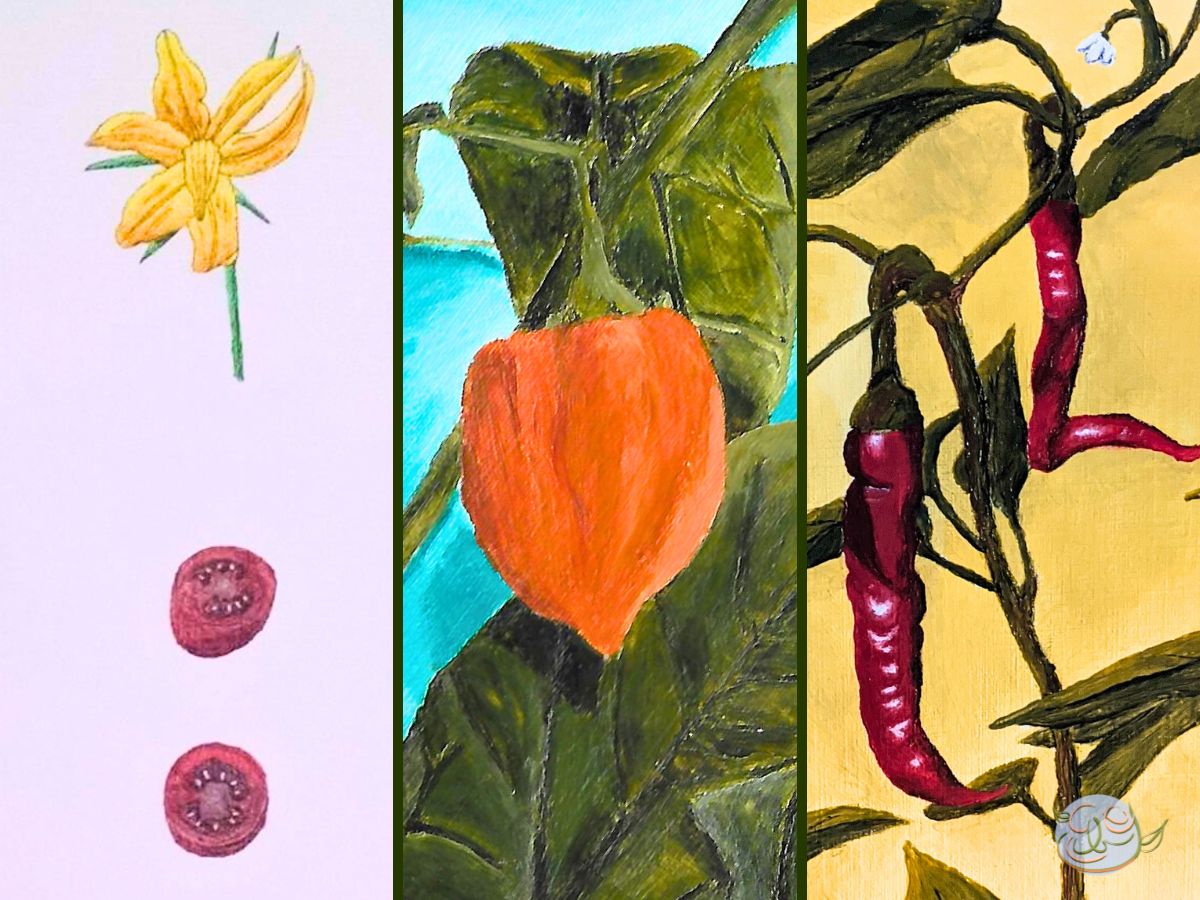

While many people in the United States know April 15th as Tax Day, when Americans’ taxes generally come due to the Federal government, I prefer to focus on a much more positive aspect of the day. April 15th is also World Art Day! And this year, I couldn’t ignore the chosen theme for World Art Day 2024: A Garden of Expression.
In addition to gardening and reading, art is a huge part of my hobbies. All the photographs on this blog are taken by either myself or my husband, and I’ve spent a considerable amount of time photographing, drawing, and painting my plants. My garden is my primary subject and I am delighted to have cultivated not only such wonderful plants, but also the talent to preserve their beauty in art. For World Art Day, I wanted to celebrate my garden with a post on these artistic endeavors. I invite you along for the journey!
Normally, it is my goal to keep the images in our articles at 1200 x 630 pixels, landscape, a recommended ratio which keeps website loading times down while maintaining image clarity. For this post, I’ve elected to make some images slightly larger or in different ratios to show them off in all their glory. For further image clarity, you can click on some images to view them full screen.
What is World Art Day?
The United Nations Educational, Scientific and Cultural Organization (UNESCO) created World Art Day at the 40th session of their General Conference on 26 November 2019. The goal of the celebration is to recognize “the contribution of art in the diffusion of knowledge and its importance for nurturing creativity, innovation and cultural diversity, Underlining the need to support the development of art as a means to achieve a more developed, free and peaceful world”.
Like many such celebrated days, the theme for World Art Day changes from year to year. This year, the International Association of Art / USA (IAA/USA) declared the 2024 theme to be A Garden of Expression: Cultivating Community Through Art. IAA/USA is a Los Angeles-headquartered branch of the International Association of Art/ Association Internationale des Arts Plastiques (IAA/AIAP). The IIA/AIAP is headquartered in Paris, France. Both the IIA/AIAP and the IIA/USA partner with UNESCO.
Why is April 15 World Art Day?
UNESCO chose April 15th as World Art Day because it is the birthdate of Leonardo da Vinci. Da Vinci is widely considered one of the greatest artists of all time. So, World Art Day celebrates his birthday.
Leonardo da Vinci (1452-1519) was a Renaissance artist who painted in the Florentine tradition. Though many argue that he broke from Florentine’s bold lines to create more subtle shaded edges, as in his most famous painting, the Mona Lisa. This subtle shading is called sfumato, which in Italian means “nuanced”.
World Art Day Ideas
The theme for 2024’s World Art Day aside, gardens, flowers, vegetables, leaves, and all natural elements have been subjects of art for millennia. You don’t have to be a talented, renowned artist like Leonardo da Vinci to celebrate World Art Day.
Sketchbook Art
Simple sketches with pencil and paper can be enough to draw a flower, a fruit, or a leaf. Nature is an often inspiration for my bullet journals. For example, July 2021 was the month of the tomato in my notebook.

Even if you have no artistic ability whatsoever, you can take a crayon or pencil and make a leaf-rubbing. I often make leaf rubbings like these for my journals in the fall. Saved leaves lose their color so quickly. So leaf rubbings are my attempt to preserve the colors of autumn in some meaningful way.

Botanical Art
Also referred to as Botanical Illustration, botanical art involves sketching, painting, or otherwise noting the individual elements of a single plant. Botanical illustrations contain elements of science to them. In the case of a flower, the art may showcase the petals, stamen, and sepals. In the case of a vegetable, the art may show cross-sections of fruit and seeds. Many botanical illustrations even show the plant’s root system. While designed as educational tools, these illustrations are every bit worthy of consideration for World Art Day.
The Unlikely Indeterminant Cherry Tomato
My first foray into the art style of botanical illustration started as a means of identifying a plant. In the spring of 2014, we had planted Thomas Jefferson Cayenne Peppers for the first time. Back then, we often used our patio to plant our seeds in small seed starters where we watered them thoroughly before bringing them indoors to germinate. The only thing I can think happened is that a bird flew overhead while we were planting and delivered a gift to our seed starters at exactly the right time. As the seedlings grew, one of them was clearly not like the others.

Rather than pluck out this stranger, I proceeded to sketch the curious plant in an effort to understand it. I called it my “plant study”. As the plant grew, so did my botanical drawing. Creating this piece of art allowed me to finally identify the imposter pepper plant as a cherry tomato plant whom we affectionately named Goliath. In fact, we grow seeds from this plant today. I later used watercolors to paint my botanical illustration and framed it.
The finished piece hung in our kitchen for five years before it began to fade from the sunlight and required a touch-up of color in 2019.

This piece of botanical art now hangs in our kitchen behind UV glass to protect it from sunlight damage. Hopefully, it won’t require re-touching again.

Realism
As I have grown in my artistic and gardening skills, I’ve discovered that my style is one of realism. Realism is the artistic style that conveys in a medium (canvas, paper, pencil, paint, or otherwise), the real world as it truly exists. Like taking a photo, but sketching or painting the subject instead.
While I long to be able to paint or draw in the impressionist or even comic style, it’s just not the way my talent is wired. If my subject isn’t directly in front of me, or sitting next to my notebook or easel in photo form, I cannot convey it to my paper or canvas in any meaningful way. I envy those who can render images into the world from nothing more than their own imaginations and their chosen medium. If that is you, please accept my, “Bravo! Brava!” as I cheer you on.
Happily, for garden art, realism is a boon and not a bane.
I have placed my skills at artistic realism to work painting the plants that we grow here at Eastborn Gardens. My artistic subjects so far have been the Thomas Jefferson Cayenne Peppers and our variety of Orange Habaneros. For World Art Day, I am proud to showcase these. Both started out their lives as pictures that I took of our plants. Both are rendered in acrylic on canvas-paper with a glossy additive to give the acrylic paint a little bulk and shine.
Orange Habanero Peppers
My first foray into acrylic art was to paint the very first habanero plant that we grew. These seeds came to us from the Indianapolis Public Library’s seed library program at their Glendale, IN branch, near where we were living at the time. If your local library has a seed library, I highly recommend you visit it! If they don’t, I highly recommend you suggest it.

After selecting a photo of my beloved habanero plant, I first sketched it onto the canvas-paper in pencil then proceeded to paint the background without the glossy additive. My goal was to allow the peppers and the leaves themselves to pop because only they would have the glossy additive.
I already owned the teal color that would make up the background left over from a previous project (and I thought the teal would handsomely offset the orange of the habaneros). However, I saved money on my art supplies by only buying Red, Yellow, Blue, White, and Black. So, after the background was painted, I mixed all the colors except the background teal myself to paint the plant and fruit.

By the time I finished, I was extremely pleased with the way the painting had turned out. The orange that I mixed was just right. While I worried that the leaves were too dark and the shadows on the habanero fruit would look like bruises, the end product is something I can be proud to showcase for World Art Day.
First, a look at the initial photo:

And then, the final rendition of artistic realism:

Thomas Jefferson Cayenne Peppers
Although these plants were some of the first we grew, they are the most recent that I have painted. I followed a similar method to the habanero painting above, but added a little of the glossy additive to the background this time. I didn’t think that teal would suit the background of cayennes. In fact, I worried a blue-ish background with a dark red fruit would unnecessarily weigh down the plant portrait. So, decided to mix all the colors myself and start from a yellow background. The results were fantastic.
As before, I think it’s only fair that you see the initial photo that allowed the realism painting of these cayenne peppers to come to pass.

And then, the final form:

Photography
Let us not forget the art of photography! As mentioned above, both the acrylic paintings of my beloved peppers started out as photographs. If not for those, as an artist of realism, there would be no way I could have painted these plants.
All the photos on this blog are a product of either mine or my husband’s cameras. While I do own and frequently use a Lumix DSLR camera, the best camera is the one you have with you. So, we often take photos with nothing more than our cell phones. Cell phone cameras have come a long way in the last several years, so don’t discount the work they can accomplish!
Join Us! Coloring Book Templates for World Art Day
Before I started painting the acrylic versions of the habaneros and the cayennes above, I also scanned the sketches of these beauties for a different use. I now leave them here for you, dear readers, artists, and gardeners, for your delight. Feel free to save these photos down and print them out for you and your loved ones to color on World Art Day, April 15th. Click the images to open a printable PDF.


Coloring isn’t just for kids, either! Grab some crayons, markers, colored pencils, or even just a regular pencil and do some shading work! Art is up to you.
Happy World Art Day!
If you’re not ready to tackle some garden art on April 15th, fear not! There are lots of other art days, weeks, and months celebrated around the world. Here’s just a few:
- February Art Month – the Philippines’ art month sponsored by the National Commission for culture and the arts (NCCA).
- American Painter’s Day – February 3rd.
- Drawing Day – celebrated on May 16.
- World Watercolor Month – observed annually in July, celebrates art and creativity through the use of watercolors.
- August is recognized as American Artist Appreciation Month
- October Art Month – established in 1993 and is observed every October throughout the United States.
- October 25th is the birthday of Spanish Artist Pablo Picasso.