
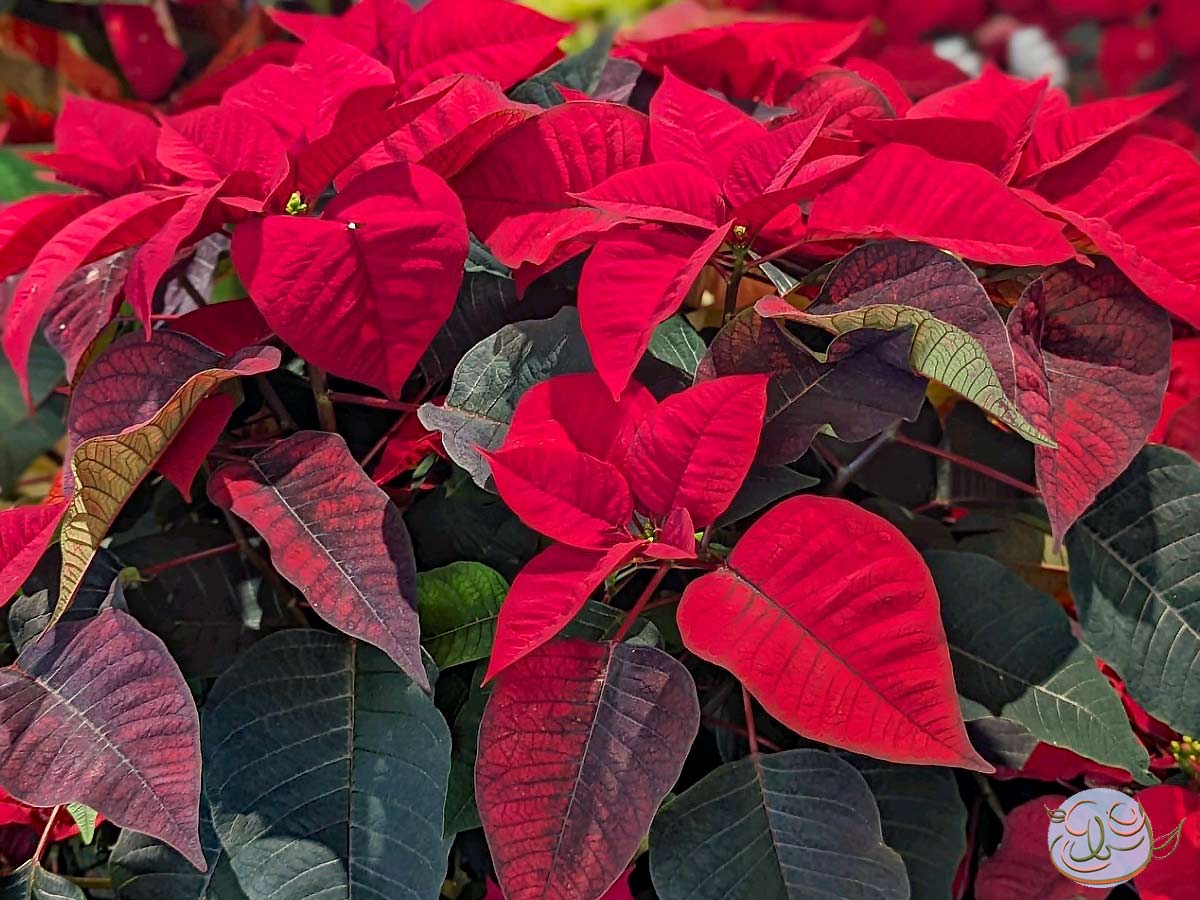
If you live in the United States of America, it’s impossible to visit a store during this time of year and not see with the showy sight of bright red, white, or multicolored heads of Poinsettias. Poinsettias are a featured player in the commercialization of the holiday festivities. It turns out the history of the poinsettia is a rather interesting tale. This week, I wanted to delve into the history of how the poinsettia singlehandedly took over the plant industry for a month out of the year.
The History of Poinsettias Originated in Mexico
The plant is native to the rocky canyons of present-day Southwest Mexico and Guatemala. There, it was well known to the Aztecs and Mayans. The Aztec called it Cuetlaxochitl, which means “Brilliant flower” or “Star Flower,” while the Mayans called it K’alul wits, “Fire Flower.” Both monikers give clear representation of the plant’s red bracts. Many flowers, like Anthuriums, have bracts, the supporting leaves that draw pollinators’ attention to the small, yellow flowers.

Long before the European explorers came to the new world, the Aztecs and Mayans used the Cuetlaxochitl. They used the plant for dye, for medicines, and in their religious ceremonies. When the native societies boiled the yellow inflorences (the flowers) and the red bracts, they believed it a remedy for illnesses. The boiled root of the plant, for example, could relieve anyone from the effects of snakebites. In fact, a published educational report from the University of Massachusetts says the Teenek tribe of South-eastern Mexico still use the poinsettia today for these same remedies.
Netzahualocoyotl and Montezuma, caciques (or chiefs) of the Aztecs, both considered the Cuetlaxochitl as an important plant. To them, the plant signified purity.
Spanish Conquest of Mexico and the History of the Poinsettia
After Cortés’ conquest of Mexico, journals wrote about the plant among other plants of the region. These journals were written in Spanish but include the names of the plants in the local Nahuatl dialect and not in any recognizable form we know today.
So, it wasn’t until Francisco Hernández came along that the Europeans wrote down anything substantial for the history books about the Cuetlaxochitl plant (later poinsettia). Francisco Hernández lived from 1515 to 1587 and was a physician to King Philip II of Spain. Hernández travelled to Nueva España, (New Spain, roughly Mesoamerica) from 1571 to 1577 where he worked as the protomedico, the public health official, for the New World.

Hernández wrote many manuscripts during this time on the plant and animal life of the region. These manuscripts were later edited and translated into Latin, the scholarly language of the time. One of his manuscripts, now referred to as the Rome Edition, “Rerum medicarum Novae Hispaniae thesaurus” (edited in 1651), even contained woodcuts of some of the plants and animals that Hernández described. Hernández appears to describe the Cuetlaxochitl to fellow Europeans in a Madrid Edition of his works (edited in 1790) for the first time.
“It is a medium-sized tree with three-pointed and sinuous leaves on either side, and very large red flowers, very similar, except for color, to the leaves of the tree itself. The leaves increase the milk to the nurses, even the elderly, whether they eat them raw or cooked as a vegetable, or that they lick the latex that flows from them. Born in any regions, scan cold or fiery, and happily and beautifully decorate the orchards and courtyards of the Indians”
Hernandez, Liber VI, caput CXXXVII, Madrid edition, edited 1790, 2: 189, then translated from Latin to Spanish in 1942 by an “anonymous commentator” in 1942-1946 for the Instituto de Biologia de México, translated further into English by myself for the purposes of this blog. (LACK, H. WALTER. “The Discovery, Naming and Typification of Euphorbia Pulcherrima (Euphorbiaceae).” Willdenowia, vol. 41, no. 2, 2011, pp. 301–09. JSTOR, http://www.jstor.org/stable/41548995. Accessed 1 Dec. 2023.)
Historical Significance: The Poinsettia’s Holiday Association

One reason we now associate this flower with the holidays is due to Aztec religious ceremonies. Surely the Europeans observed these ceremonies when they arrived in the new world. In the 17th Century, Franciscan priests settled near Taxco, a town in Southern Mexico. There, they noted that the plant bloomed at the beginning of the winter season. The Franciscan priests included the flower in their Fiesta of Santa Pesebre, a nativity procession.
They called the star shape of the leaves as a symbol of the star of Bethlehem in the Christian Bible. And they adopted a pretty little apocryphal story to show a Christian miracle. It’s this story that gives the plant its Mexican name, “Flores de Noche Buena” (Spanish for “Flowers of the Good Night”).
How Did the Poinsettia Come to America?

From 1822 to 1823, President John Quincy Adams appointed Special Envoy Joel Roberts Poinsett (1799 – 1851) as the representative of the United States in Mexico. Poinsett later served as United States Ambassador to Mexico from 1825 to 1829. When not involved in international relations, Joel R. Poinsett’s hobby was botany. During his time in Mexico, he acquired live samples of the Flores de Noche Buena. He then sent those samples to his home of Charleston, South Carolina in 1828, and to Philadelphia. In Philadelphia, the Bartram family then cultivated the plant.
“The Botanical Garden of Bartram received some years ago from Mr. Poinsett our ambassador in Mexico, a fine new green-house shrub, akin to Euphorbia, with splendid scarlet blossoms or rather bracts”
C. S. Rafinesque (1783 – 1840) Atlantic Journal, 1833 (LACK, H. WALTER. “The Discovery, Naming and Typification of Euphorbia Pulcherrima (Euphorbiaceae).” Willdenowia, vol. 41, no. 2, 2011, pp. 301–09. JSTOR, http://www.jstor.org/stable/41548995. Accessed 1 Dec. 2023.)
Euphorbia has survived through history as the family name of the Poinsettia today. However, coming up with a common species name took much more time. Spain received plant samples in the form of cuttings from Mexico to Spain by the Sessé and Mociño Expedition (officially titled “The Royal Botanical Expedition to New Spain”). They annotated these specimens as Euphorbia fastuosa.
Naming the Poinsettia

A previous expedition had come across the plant before Poinsett, arriving in Acapulco on 22 March 1803. The expedition was comprised of Alexander Freiherr von Humboldt (1769-1859) and others. Humboldt took cuttings and sent them back to the Old World in the care of his mentor Carl Ludwig Willdenow (1765 – 1812). Willdenow referred to these specimens with labels of E. coccinea and E. diversifolia. “E” clearly denotes that recognized it as Euphorbia, but the species name continued to change. Even when Poinsett sent his living samples to the Bartram family, they categorized the plants as E. poinseti or E. coccinea.
Throughout the poinsettia’s history, a total of four different scientific names described the plant. (Technically five if you count an error made on paper in 1833). It finally came to its currently accepted scientific name in 1834 of Euphorbia pulcherrima. The name appears first in a garden journal by Johann Friedrich Klotzch (1805-1860). A mining engineer in Mexico from 1827 to 1832 with an interest in botany sent Klotzch two living Euporbias. The plant continued to change names for a while even after that. We can thank Curtis’s Botanical Magazine for the current scientific name of Euphorbia pulcherrima as the scientific name of the common poinsettia.
How Did Poinsettias Become Associated with the Holidays?

Even then, in America, people didn’t widely associate the poinsettia with the holiday season until the mid-20th century. Poinsettias didn’t become part of the holiday historical landscape until Paul Ecke Jr. of the Ecke Ranch Company got involved. Ecke Jr. sent free plants to television stations for them to display on the air from Thanksgiving to Christmas. These plants even appeared on such television programs as The Tonight Show and Bob Hope’s Christmas specials, promoting the plants. On July 22, 2002, in House Resolution 471, the United States House of Representatives of the 107th Congress officially acknowledged December 12th, the day of Joel Roberts Poinsett’s death, as Poinsettia Day.
It’s easy to find the full text of the resolution. All historical resolutions are made public and the poinsettia resolution is no different. As H.Res.471 of the 107th Congress attests, the resolution was made on the death of Paul Ecke Jr.. Likely the monetary contributions didn’t hurt the cause either. The resolution mentions “$256,000,000 in sales at the wholesale level to the United States economy alone.” As well as the “funding for floral and nursery crops in the research budget of the United States Department of Agriculture.”.
Now You Know the History of the Poinsettia
So, there you have the history behind the Poinsettia as a holiday tradition today. Aztecs and Mayans, Franciscan monks, a television fad, and money contributed to the US economy earned the Poinsettia a special day of its own.
Does any of the poinsettia’s history take away from the beauty of the plant? I don’t think it does. A plant’s meaning is what we give it. And yes, it’s many names may be confusing: Poinsettia, Les Flores de Noche Buena, the Cuetlaxochitl. So, maybe we should call it by the scientific name Euphorbia (which is about as unbiased as we’re going to get). It is still a plant, a living thing that breathes, grows, and gives joy where it can … including this holiday season.



2 responses to “Poinsettia History: How a Mexican Flower Became a Symbol of the Holiday Season”
[…] There are many symbols of this holiday season. The candle, the evergreen tree, the wreath, the Yule log, the robin, the dove, the minora, the manger scene, the jolly old man who brings toys, etc. As a gardener, one of my favorite symbols of this time of year is the poinsettia. Why is the Poinsettia a holiday tradition? It’s quite a story! Check out this blog post on: Poinsettia History: How a Mexican Flower Became a Symbol of the Holiday Season […]
[…] spent most of this month talking about the poinsettia plant, both of the Poinsettia History: How a Mexican Flower Became a Symbol of the Holiday Season, and a funny (and true) Poinsettia Holiday Story. Not to be left out, the US Botanic Garden […]