
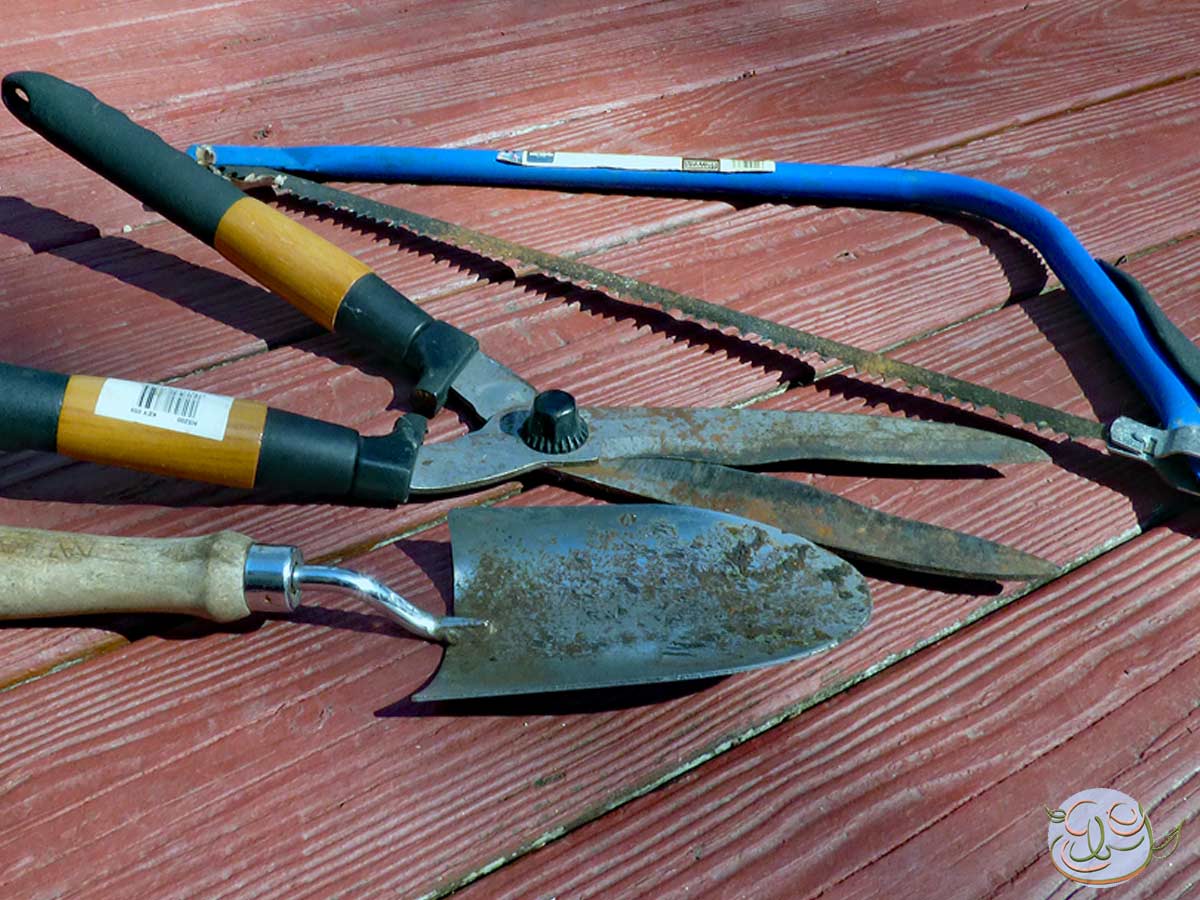
Even if you’re not careless with your garden tools, over time all iron-based tools acquire rust. As I was putting away my garden tools for the winter I realized how incredibly rusty they’d become. Years of cutting, sheering, hammering, and frankly just general use had been a little hard on my tools. I wanted to know the best way to remove the rust from my tools and bring them back to good condition. But the problem was: how to go about removing the rust?
There’s a lot of confusion about the best home remedies to remove rust. Some of which are, frankly, outright lies. There’s also a lot of products on the market made specifically to remove rust. Some of which can get quite expensive. So I decided to do a little experiment on the home remedy side of things. What materials do we normally have sitting around the house that will effectively, and quickly, remove rust?
Before We Remove It, Just What Is Rust Anyway?

Rust (chemically written Fe2O3) is the natural result of iron (Fe) coming in contact with oxygen (O). This is referred to as Oxidation. As iron oxidizes, it corrodes, or deteriorates, into oxide powder. Essentially, this is the natural decomposition of an iron artifact (like garden tools) over time. Also, water (H2O), with its oxygen component, speeds the corrosive effects of oxidation. In plain English, water makes iron rusts faster.
Because I’m a bit of a geek about these things, I did take the time to look up the chemical formula for rusting: 4Fe + 3O2 + 6H2O → 4Fe(OH)3. (Shout out to Vedantu.com, an online K-12 teaching program started in India and now worldwide, and their article on rust’s chemical properties for the quick answer.)
If rust is left to its own devices, it will slowly weaken the material, flaking it away and causing pitting. This renders the object useless after a period of time. This is dangerous in the case of load bearing iron objects, like screws or supports. Also, since many tools we rely on receive a degree of thrust on them when used (like hammers, pliers, shears, saws, etc.) this makes rust a liability on tools too.
As such, it’s essential to keep your tools in good condition by examining them once or twice a year for rust, and taking steps to remove that rust when it’s found.
Can You Prevent Rust From Forming?
Not really, no. Because this is Earth, oxygen is all around us. Also water is in the air as humidity and clings to cool metal as condensation. As mentioned above, this will speed up the rusting effect. You can reduce rust in your tools only by buying tools made of metals that don’t contain iron, don’t contain as much of it, or have materials ingrained to protect against rust.
Some materials used in tools that don’t rust are:
- Aluminum (its coating prevents rust, though aluminum itself corrodes if the coating is breached)
- Copper (though it also oxidizes, just differently)
- Brass (like copper, it oxidizes, but this doesn’t corrode the material)
- Galvanized Steel (does rust, but rusts slower due to its coating of zinc which corrodes slower)
- Stainless Steel (also rusts, but slower due to its chromium aspects)
Ways to (and Ways Not To) Remove Rust
The internet is a fountain of human knowledge. As such there is a lot of advice out there. But how many of these ideas actually work to remove rust? After a couple weeks of research and pulling up the best (and worst?) of what the internet had to offer, I was ready to start my experiments.
Method
First of all, I needed some rusty items to test. No way were my my trusty (if rusty) garden tools going to be test subjects. I had tons of paperclips sitting around my home office from my days as a brown-burlap cube office worker. Let’s be honest, paperclips are largely a thing of the past. Paperclips are a great test subject since they’re made of mostly iron. This means they rust quickly. Nothing like some time in water where the air can get to them to cause rust to form.

(I threw in some safety pins that I’d been wearing on my running belt too. Apparently, running in the rain is a good way to get safety pins to rust too.)
Setting Up the Experiment
I set up some test environments using the things I saw mentioned most often on the internet. For this experiment, I used some shallow ceramic bowls that once contained desserts, but now are the perfect paint pallets, plant trays, and dishes for experiments just like this one.
The kinds of products I tested were things I already had about the house: Vinegar, Citric Acid, Cola, Hydrogen Peroxide, and OxiClean. I already had my theories about which would work the best. But I wanted to see it in action. I also added about a quarter cup of water to each one which helped to dilute the solution enough to see the reaction I expected to take place.

For clarity, successfully removing rust involves not only dislodging the rust from the items, but also avoiding the metal becoming more pitted. After all, the idea is to save our tools from rust and preserve them from decay. This experiment is a failure if we harm our tools in the process. I left the items in their solutions for 24 hours for the best possible effect. Also, we used steel wool at the end of this experiment to fully dislodge the rust from the items.
What Worked to Remove Rust
Let’s start with why you’re likely reading this article to begin with. What can you use to remove rust from your tools? And what works the best?
Citric Acid

Citric acid sits between 3 and 6 on the pH scale, which means its considered lightly acidic. I have citric acid at my house because it’s a good addition when making shelf-stable infused olive oils. I talk about citric acid for this use in the post Homemade Infused Olive Oil With Your Own Garden Produce.
During the experiment, the ceramic bowl with the citric acid produced bubbles, so I had high hopes for the citric acid solution. After rinsing and rubbing lightly with steel wool, the results were pretty good. The items ended up a little tarnished from the rust’s affects, but overall much better than they had been to start with.
Vinegar

White vinegar sits at about 2.4 on the pH scale, which makes it more acidic than citric acid. As I checked up on my experiment several times, the vinegar dish appeared to dissolve the rust the quickest. After only about an hour, I was able to see some of the metal beneath the rust showing through.
After rinsing and lightly rubbing with steel wool, the metal beneath the rust was largely unpitted and shiny again. A pretty good result.
Cola

Cola sits at about 2.6 to 2.7 on the pH scale, mostly due to phosphoric acid (H3PO4). It also contains carbon dioxide (CO2), which produces the fizziness, but doesn’t affect the acidity any. I honestly wasn’t sure what to expect from cola, but I’d heard that road crews sometimes use it to clean blacktop after bad vehicle accidents.
The dark color of the cola and the bubbles made it difficult to tell what was going on during the process, but the after effects were unmistakable. Clearly the best of the lot, the cola removed the rust from the paperclips beautifully, didn’t pit the surface, and even left them shiny once more. A clear winner.
What Didn’t Remove Rust
Don’t always trust what you read on the internet. After my deep dive into the internet’s trove of “wisdom”, and testing it out, I came up with a few so-called “rust removal methods” that absolutely do not work.
OxiClean

With “Oxi” directly in the title of this product, my hypothesis was that this wouldn’t work at all. In fact, I had my doubts from the moment I read it as an option on the internet. But since I had it in my laundry room, why not give it a try?
This solution was a clear loser. OxiClean sits at 10.5 on the pH scale, which makes it a basic rather than an acid. I’m not sure that the solution did anything at all to the paperclips. The “better” result of the after photo may simply be due to the rinsing and buffing the paperclips with steel wool performed afterwards. The paperclips ended up extremely pitted. I wouldn’t trust it to remove rust from my garden tools – or laundry – at all.
Hydrogen Peroxide

At first glance, hydrogen peroxide may have appeared to work. However, take a look at the heavy pitting that remains after rinsing the paperclips and rubbing with steel wool. If this happened to my garden tools, I think I’d be very upset. Rubbing with the steel wool only managed to flake more of the metal away, leaving the items extremely pitted and rough to the touch.
Hydrogen peroxide is considered acidic with a pH of about 4.5. Chemically written as H2O2, hydrogen peroxide is literally 2 atoms of hydrogen mixed with 2 atoms of oxygen. Break that chemical down and you essentially have water (H2O) with an extra oxygen atom. Just as mentioned above, rust forms when iron comes in contact with oxygen. Placing iron in hydrogen peroxide only makes it more rusty, not less.
Results Are In

So, the final tally to end the experiment was:
- Cola – Removed the rust and even returned the shine to the paperclips.
- Vinegar – Appeared to remove rust the quickest, but left the paperclips dull.
- Citric Acid – Bubbled during removing rust, but left items lightly pitted.
- OxiClean – No real visible reaction to remove rust one way or the other, paperclips visibly pitted.
- Hydrogen Peroxide – Items sustained heavy corrosion and likely left in worse condition than before the solution.
Finally Removing the Rust from the Garden Tools
Now that I knew what method worked best, my new knowledge went immediately to polishing my garden tools. I wanted to put them away for the winter pretty and clean so they’ll be ready to go come the spring. But honestly, this is a good chore for either end of the gardening season or the beginning of it.
We (my husband helped) separated the blades of the garden sheers by unscrewing the hex bolt so the cola solution had the best possible ability to get at all sides of the rusted metal. I also threw in one of my metal garden trowels which has been rusted for years and really needed some TLC. We ended up using about 3 liters of cola with a little water to dilute it slightly, just as I’d done in the experiment I’d just performed.

Steeling Ourselves … and Our Tools
After leaving the tools in the cola solution for a little more than 24 hours, we rinsed them and lightly buffed them with the steel wool, just as in the experiment. The steel wool is an important step that you cannot skip. Solutions that help to eliminate rust only loosen the rust’s hold on the iron, not dissolve it entirely. You’ll need to scrub at your garden tools with steel wool to fully break the rust free.
Here’s an in-progress photo of cleaning the rust from the pair of garden shears. We’d finished one blade and took this photo before beginning the steel wool treatment on the other blade.

Once you remove the rust as best you can, you should then wipe them down with WD-40 to help preserve the metal.
Because these tools rusted over the course of several years, pitting in the steel inevitably occurred. Removing the rust from your garden tools doesn’t mean they’ll be like new, but it will preserve them and extend their lifespans. Also, my garden trowel is chrome-plated. Once the rust took hold, some of the chrome plating stripped away. Still, the final result was pretty striking.


Your Turn!
Now you know how best to clean your garden tools. Use cola and a little bit of steel wool to send rust on its way and stop it from eating at your expensive garden tools. If you know of other methods to remove rust, don’t hesitate to leave a comment and let me know! I’d be happy to revisit this topic at a later date to see if cola can maintain its champion status as a rust remover.
Until then, good luck with your garden tools!



2 responses to “Removing Rust From Your Garden Tools”
[…] need. Do you have tools needing maintenance like rusty garden spades or dull pruning sheers? There are several ways to take care of rusty tools, but they do take effort. Make a note and schedule a time to take care of those chores before you […]
[…] my tools or raised beds need maintenance? Does my soil need […]