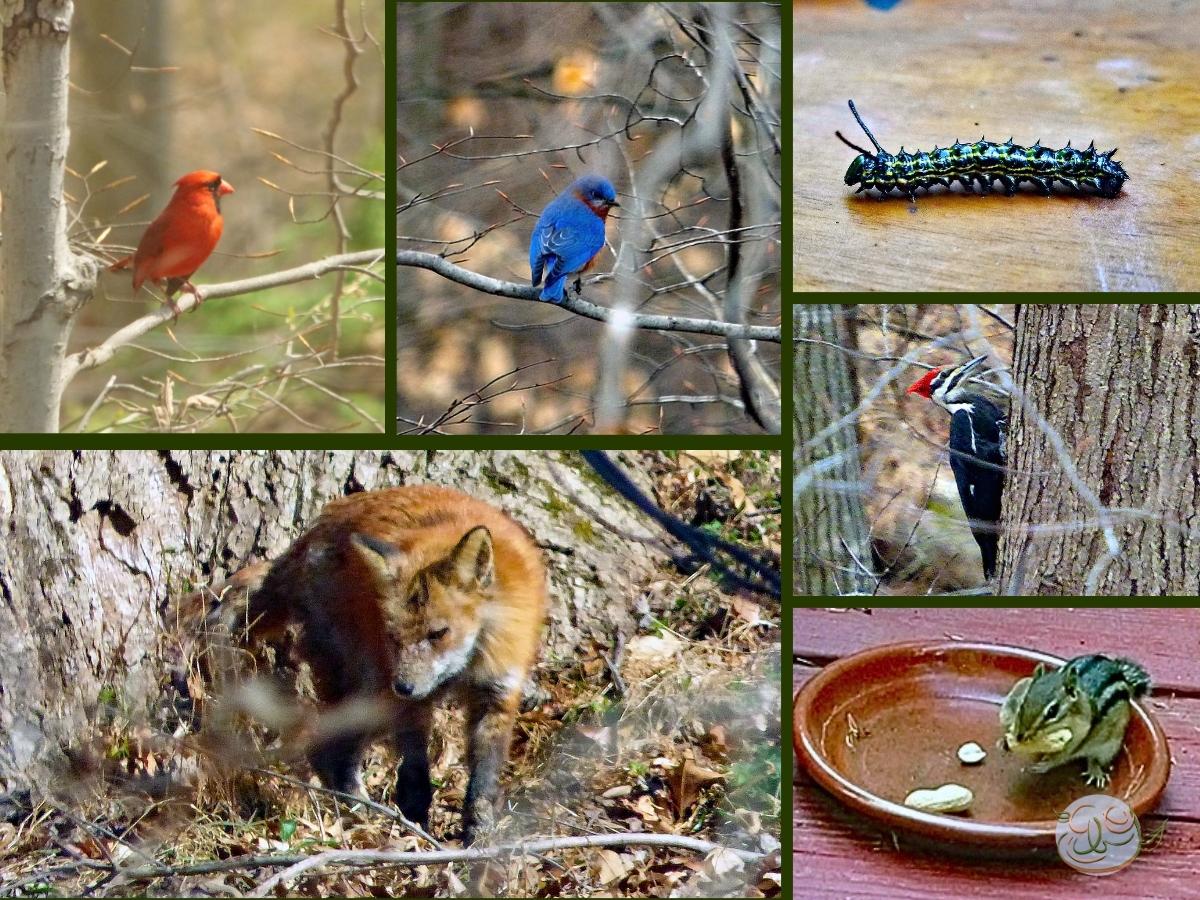
A garden is so much more than a place to grow plants. It’s also a communal place to spend time with nature. Of course, wildlife spends a fair amount of time there too. For a lot of gardeners, having creatures in our carefully prepared garden is a nuisance. Insects and animals alike quickly become pests in the garden if they get a foothold. A lot of a gardener’s time is spent inspecting plants for troubles to catch pest problems early. I like to call the wildlife that visits my corner of cultivated earth my garden visitors. I spent my last post giving my garden its 2023 annual review. (Missed it? You can find it here!) I also wanted to take a bit of time reflecting on the garden visitors we’ve had in 2023.
Why Call Out Garden Visitors for 2023?
It’s true that animals and insects in the garden are largely there because they find our produce as tasty and enticing as we do. Some of those garden visitors are great and even pitch in to help out. Other garden visitors become pests and end up overstaying their welcome … by a lot.
While garden visitors can be a problem, they also tell us a lot about the kind of garden we’re cultivating. This is in line with my annual garden review as it also provides me with thoughts and ideas for next year.
Feathered Garden Visitors of 2023: Birds!
Birds can be helpful or harmful visitors to the garden. Depending on the kind of plants you’re cultivating in your garden, birds can help to pollinate. They can help a little with insect control, but they can also do harm to helpful insects too. Birds can also help themselves to your garden’s berries, small tomatoes, and direct-sown seeds, taking your harvest for themselves. So I find it useful to birdwatch our feathered garden visitors so I know who is coming and going from my local area. Here’s a few of my favorites.
As with most photos on this blog, all the below pictures were taken either by me or my husband. Many pictures were taken with my Lumix DSLR with a 60x optical zoom. But the best camera is the one you have with you. So I also used my handy cell phone, too.
American Crow (Corvus brachyrhynchos)

Of course, the American Crow is a common bird to see in any sort of environment. But I think they’re underrated. It’s worth it to know if a flock of crows frequents your local area. They eat practically everything and are bullies to other birds. Happily, they stayed in the tree cover and didn’t bother our garden this year.
I didn’t realize it until I was editing these photos for clarity but I managed to catch this noisy American crow in the middle of blinking. Crows (and other birds) don’t blink like we do. They have a third semi-transparent layer that slides over their eyes to moisten them. That’s why the eyes of this crow look white.
Dark-eyed Junco (Junco hyemalis)

The Juncos in the garden this year were no joke. They were unafraid of us and sat on our fences even when we were tending the garden or enjoying the air on the garden patio. One Junco was so insistent that I named the bird “Bold.”
I’m pretty sure this is the kind of bird that built a nest in our tomato plants in 2023. Juncos like to nest in depressions on sloping ground or amid roots. Our tomatoes’ raised garden bed was the perfect invitation. I unfortunately destroyed the nest when I removed it. But I don’t feel too bad as the nest was empty and Juncos don’t reuse nests from one year to another.
Eastern Blue Bird (Sialia sialis)

Gretchen Rueben, a New York Times Best Seller writer I adore, reminds us that the bluebird is a symbol of happiness. I couldn’t agree more. (You can read her take on the bluebird at gretchenrueben.com.) A shocking blue against a grey background in spring and winter, the Eastern Blue Bird is a native bird in Northern Virginia where I live.
House Finch (Haemorhous mexicanus)

This pop of color on a dreary spring day was a delight to see. At first, second, and even third glance I wasn’t sure if what I was seeing was a house finch or a purple finch. The two are remarkably similar. On close examination, however, I determined this is a house finch due to the darker lines on the belly where the purple finch has none. The added confirmation of its birdsong leaves me with little doubt that the house finch was my garden visitor.
Northern Cardinal (Cardinal cardinalis)

Fun fact: the Northern Cardinal is the state bird of Illinois, Indiana, Kentucky, North Carolina, Ohio, Virginia, and West Virginia. That makes it the most popular bird to be named state bird. No surprise I would find one near my garden. I don’t recall seeing any of the cardinals directly in any of the garden plants this year. However, cardinals love small fruits like my cherry tomatoes, so I would not be surprised if they took an impromptu bite now and then when I wasn’t looking.
Northern Flicker (Colaptes auratus)

It was a little rare to get a photo of this northern flicker on a tree branch. Normally, when I saw this garden visitor, it was eating bugs and seeds on the ground, which is its usual feeding zones. A member of the woodpecker family, he has a similar diet to the piliated woodpecker mentioned below. But the two seemed to co-exist peacefully. Looking at the size of this northern flicker, I don’t think he’s starving.
Pileated Woodpecker (Dryocopus pileatus)

One of the first birds I spotted when I moved to the Eastern seaboard in 2022 was the Pileated Woodpecker. With its distinctive red crest and knocking on trees to get at the insects within, it’s hard to ignore. Add in its noisy birdsong that warns everyone nearby that it’s coming in for a landing, and this bird is a definite show-off. (I wish I’d thought to record its birdsong in 2023, but alas, I didn’t. But please enjoy a clip I took in 2022 to hear for yourself.)
The closest the woodpeckers have gotten to the garden is the soil on the easement, but it’s a fun bird to watch from the garden patio.
Feathered 2023 Garden Visitors Too Shy For Pictures!
Some visiting birds have been just too fast to catch with the camera or kept hidden behind the leaves when the canopy grew in. We know they’re there, though! Birdsong is one key indicator of what types of birds are living in your local vicinity. There are phone apps that make birdsong identification a breeze. My favorite birdsong app is BirdNET from Cornell Lab of Ornithology at Cornell University and Chemnitz University of Technology. If you’ve enjoyed the audio clips I’ve included above, those recordings were made with the BirdNET app. Some unseen songsters we heard this year are:
- American Robin – A classic bird seen nearly everywhere in America.
- Blue Jay – So noisy! Especially when they’re in a turf war. They make so many different kinds of birdcalls too.
- Carolina Wren – Noisy garden visitor for its tiny size! Only 12 to 14 cm long and weighing only about 20 grams (that’s about 20 paperclips)!
- Gray Catbird – These little guys really own their name. They sound exactly like our old and well-loved cat when she wanted something. “MEHK!”
- Mourning Dove – If there’s a more calming sound than a mourning dove, I don’t know what it could be. Starting low and cresting high, the sound feels like the sound of the ocean in the middle of the woods.
- Red-shouldered Hawk – This bird of prey was flying high above the canopy and out of camera range when I heard him. An impressive bird call that sent the chipmunks scurrying.
- Tufted Titmouse – I almost captured a photo of this little guy but he flew off. The cute little grey tuft on top of its head gives this bird its name.
- Wood Thrush – An ethereal sound that echoed through the early morning air.
4 Legged Mammal Garden Visitors of 2023
Because our house juts against a forested plot of public land, we get a lot of animal visitors that we otherwise wouldn’t get the opportunity to see. Most (though not all) of these animals keep to the forest line and don’t venture near our plants. Still, I include them here as 2023 visitors because they are part of the local ecosystem and useful to keep in mind when planning next year’s garden.
Eastern Chipmunk (Tamias striatus)

We have 2 chipmunks that have dens in our backyard. We can identify them by sight. Chuckles lives under our garden patio while Skinny Vinny (or just Vinny for short) lives in a den about 6 feet from the patio. They are male chipmunks and do fight each other for territory. Chuckles is better fed and older than Vinny by about 2 seasons, but Vinny has the boldness of youth.
These chipmunks are Eastern Chipmunks (Tamias striatus) rather than Least Chipmunks (Tamias minimus). Least chipmunks are smaller than eastern chipmunks. In addition, eastern chipmunks’ stripes fade out toward the tail while least chipmunks’ back stripes are continuous. Although difficult to see in the above photo, I can assure you I have enough contact with these little guys to know for sure that they’re the eastern variety.
Many gardeners, homeowners, and landscapers, find chipmunks annoying creatures who destroy a lot of hard work. They’re right. But they’re also adorable … and smart. They can be taught. We’ve learned to live with our chipmunk friends and try to gently teach them what is acceptable and unacceptable behavior in our garden. We take measures to keep them out of our planters and raised beds that make it not worth their while and entice them away from our garden with a snack plate of their very own.
Red Fox (Vulpes vulpes)

The forest that abuts our garden is teeming with red foxes. It was a delight to see them playing with one another in sight of our back garden porch. They never come near the housing, but they visit close enough to capture some adorable photographs.
4-Legged Lizard & Amphibian Garden Visitors of 2023
I was going to lump these guys in with the other 4-legged garden visitors. But that seemed disingenuous. These cold-blooded friends deserve their time in the limelight too!
Blue-Tailed Skink (Plestiodon skiltonianus)

These blue-tailed skinks are active during the middle of the day, usually while I’m on the garden patio reading a book. Blue-tailed skinks are also called western skinks and have the most interesting blue tail. These creatures hang out both at the front and back of the house, but particularly enjoy sunning themselves on top of the black grill cover. Skinks eat all kinds of bugs, both pests to the garden, like flies, and those helpful to the garden, like earthworms. They are omnivores and also eat small berries … such as the mock strawberries in our front lawn.
Eastern Gray Tree Frog (Dryophytes versicolor)

Known in some places as the Chameleon Tree Frog, this little guy has the ability to change its coloring depending on temperature and what’s around it. I was stunned to find it nestled into a corner of the window on the back garden patio. There, it had successfully mimicked the color of the trim around the window. Amazing!
They’re helpful visitors to the garden as they eat mites, aphids, snails, slugs, and spiders. Which explains why this one was attracted to our garden this year. We certainly had plenty of insects for it to feed upon.
6 Legged Garden Visitors of 2023: Insects
Love ’em or hate ’em, insects will always be a part of a garden. In fact, a garden can’t really get along without insects as pollinators to flowers, and churning through the soil to provide our plants with nutrients. We had some particularly bad pests in 2023. Though not all the insects in our garden were harmful ones.
Aphids

Aphids were the real bane to our garden in 2023 and I hope they don’t become regular garden visitors. They came in numbers and really harmed our tomato plants until we put a stop to it by releasing native lady beetles. I’ve harped on these guys enough this year (You can read all about it in the post I made earlier this year: Plant Lice: The Dreaded Aphid), but it would be remiss not to include them in this post for future reference.
Harvestmen

I love these little garden visitors. There’s a myth that says these spiders carry the most deadly poison on the planet, but they pose no harm to humans because their teeth are too small to pierce flesh. This is a complete fabrication. For one, harvestmen are not spiders. They don’t spin webs and have a circular body rather than a segmented one. They’re welcome visitors to the garden since they prey on aphids, white flies, and other garden pests. I roll out the welcome mat for these guys every year.
There are many different species of harvestmen. The most commonly known is the Daddy Longlegs. For anyone interested (like I was), the harvestman pictured is an Opilio canestrinii, native to the US, but quickly becoming invasive in places like the UK.
Ladybeetles

I heard from several gardeners in many parts of the USA that Asian Ladybeetles were particularly bad this year. I hadn’t noticed any in 2022, but several were garden visitors in 2023.
Technically, we introduced convergent ladybeetles to the garden so they weren’t exactly visiting. But their presence in the garden was a natural pest deterrent that quickly overcame the aphid problem we were having, and attempted to tell the invasive ladybeetles to shop elsewhere.
I did a deep dive into what separates Asian ladybeetles from native ladybeetles in the post The Friendly (& Unfriendly) Ladybug. So be sure to check that out!
Lightning Bug

I was sad that lightning bugs were not as prolific garden visitors in 2023 as they were in 2022. Last year, it was common to see the woods adjacent to our garden alight with blinking fireflies in the early evening. This year, not so much. I was lucky to get a photo of one sheltering himself on the tomatoes during the day. I admit that I performed no scientific or even scientific-like calculations on firefly numbers when admiring my garden visitors either in 2022 or 2023. Yet I get the distinct feeling that our friendly fireflies are becoming more rare as the years go on.
I’m not alone in my thought that fireflies might be becoming extinct. Indeed, according to a National Geographic article published June 1, 2023, “In the U.S., 18 species face extinction—and experts say global species are endangered too.” – Read more at National Geographic: Fireflies are vanishing—but you can help protect them.
Orange-Tipped Oakworm Moth Larva (Anisota senatoria)

I didn’t see a single one of these caterpillars in 2022, but in 2023, they were frequent garden visitors! They were so prolific that they fell from the trees that shade our patio … sometimes while we were sitting at the patio table.
Cousin to the Pink-Striped Oakworm Moth, Orange-Tipped Oakworm Moths primarily eat oak leaves in late summer and early autumn. We have a few oak trees near us, but they’re mostly beech and birch trees. So from personal experience, I’d can confirm these garden visitors can branch out. The prolific presence of these oakworms was slightly worrying as we do have a river birch that holds a special significance for us. (You can read all about it in the post A Tale of Two Trees, where my husband guest-posts about our river birch tree for Arbor Day 2023). At least I didn’t see any of these heavy worms on our river birch. So my guess is they were happy enough eating the beech trees instead.
An Eventful List of Garden Visitors To Our 2023 Party
As you can see 2023 has been an eventful year at Eastborn Gardens! This post will end the 2023 look-backs as we’ve already started looking forward to next year. We’re coming up with a host of new topics that we hope you’ll be interested in. So if you liked this and other articles we’ve published, be sure to tell a friend about us. We don’t market this blog in any way except for our social media. So people like you who share our articles is one of the only ways we get new visitors. Thanks for reading and being one of our 2023 garden visitors to Eastborn Gardens.

Miss the 2023 Garden Recap? Check it out below!