
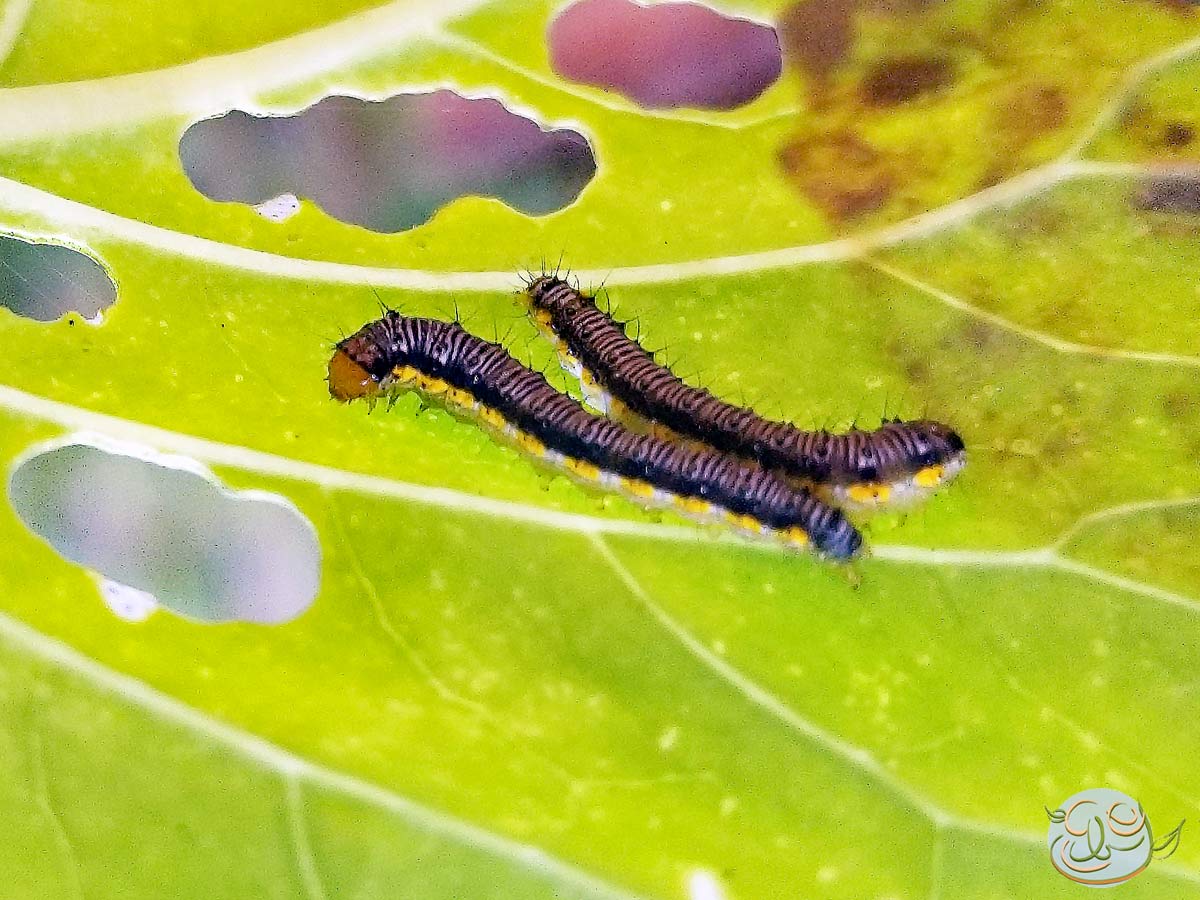
It is so heartbreaking to spend your time and effort cultivating produce for your table, only to end up feeding the local wildlife. Some garden pests can do their irreparable harm in as little as a single day. Gardeners of lettuce, cabbages, kale, spinach, brussels sprouts, and other leafy vegetables must beware of the dreaded cabbage worm.
What Does Cabbage Worm Damage Look Like?
There are many different varieties of cabbage worms. Some are light green, some have horizontal stripes, and some have vertical stripes. They all have the same love of your leafy green plants and should be treated in a similar manner. Determining whether you have a problem is a simple matter of being vigilant in the garden.
Eggs
You may be lucky and discover you have a cabbage worm problem before your problem has hatched. Cabbage moths lay their eggs in groups on the undersides of the leaves. Depending on the variety of the cabbage moth, the eggs may be green, brown, or slightly translucent in nature.
Leaf Damage

You may not notice that your plant is infested in cabbage worms until your plants are being eaten. Cabbage worms can devour an entire plant in less than a day. So you may go away for a weekend get away and come back to nothing but bare bones on your leafy vegetables.
If you do catch the infestation early enough, however, you may notice irregular holes appearing in the leaves of your leaf vegetable. Just like the children’s book The Very Hungry Caterpillar (affiliate link), cabbage worm damage really does look like someone took a bite out of your leaf vegetables. Check the undersides of your leaves for cabbage worms if you see damage like this.
Presence of Frass

Frass is the excrement of cabbage worms. When cabbage worms are present, you will notice round, black pellets on the stems and leaves of your plants. All that food that the cabbage worms are eating has to go somewhere. So if you see black frass on your plants, turn your leaves over and look for cabbage worms.
Cabbage Worms Themselves

Cabbage worms hang out on the undersides of your leaf vegetables, or in the lower outer folds of the leaf head. This added leaf cover protects them from birds and other predators that find them tasty.
Another place to look for cabbage worms are on the stems. Some cabbage worms have the exact same coloring as the plants so they blend in better. Some even camouflage themselves like the seed pods of the very plant they’re destroying.

If you spot signs like those above on your plants, lift up your leaves, peel back the outer layers of your plant, and squint an eagle eye on your stems to see if you can spot the wormy culprits.
Are Cabbage Worms Poisonous?
Nope. Unlike some caterpillars, cabbage worms are not poisonous and can be handled safely with your own hands. Hand-picking them from your plants is a tedious, but effective method of removing the worms from your plants. Many birds, including domesticated chickens, find cabbage worms to be a real treat to their diet.
If you find a worm or caterpillar that looks fuzzy, however, do NOT touch it with your bare hands. Cabbage worm hairs, if they have any at all, are so minor that they appear more slimy than furry. Caterpillars that immediately look fuzzy to the eye are another kind of caterpillar entirely. The hairs on those caterpillars may be venomous and should not be handled with bare skin.
What do Cabbage Worms Become?
There are several species of cabbage worms. Depending on the variety, they may grow up to be many different colors. The most prevalent is the White Cabbage Moth, which appears like a beautiful white butterfly, fluttering during the day as well as at night. Other varieties have more of a mottled wing coloring designed to help the moth blend in with tree bark, safe from predators. Both are fiends, not friends, to your garden.
How to Prevent Cabbage Worms in the Garden

Unfortunately, there’s very little you can do to truly prevent cabbage worms on your plants. The aerial antics of the cabbage moth generally occurs at night when we gardeners are asleep. Even during the day, it’s hard to keep winged creatures from the garden (and in the case of our friendly pollinators, we don’t want to!).
There are commercially available nets that you can drape over your plants that will prevent cabbage moths from laying their eggs on your precious plants. These nets are light enough to allow the plant to grow (albeit with a little added weight) but don’t allow the cabbage moths through the holes in the netting.
You can also deter cabbage moths with companion planting. Cabbage moths despise strong scents from herbs like mint, sage, and dill, and flowers like marigolds. Planting these strong-scented plants among your leafy greens can encourage cabbage moths to shop elsewhere.
How to Get Rid of Cabbage Worms
But what if you already have cabbage worms?! Are your plants doomed? Answer: it depends. Depending on when you spot damage to your plants, you may be able to overcome the cabbage worms, or it may be too late.
Eggs
You’re in luck! As mentioned above, cabbage moths lay their eggs in clusters on the undersides of leaves. If you see a bunch of small pods on the undersides of your leaves, hand-pick them off or wash them away with a firm jet of water from your garden hose. Your plant will have no damage if the eggs haven’t yet hatched.
Larval Moths
This is the worst. Like a late teenager returning from college for the summer, these little juvenile moths are hungry creatures that can and will devour the entire pantry in a day. However, if you act fast, you can get ahead of them and save your plant.
Cabbage worms tend to appear in mid-summer to late fall. If you find them early in the season, you can pick them off by hand or use one of the natural solutions below to save your plant. Most leafy plants like cabbages, kale, and spinach are cool weather crops that do their best growing and maturing in the fall. Catch the worms early enough in the season and stay vigilant for future attacks. Your plants still have plenty of growing season to produce food for your table before the winter.
Natural Methods to Get Rid of Cabbage Worms
Since you likely intend to eat the food that you’re growing in your garden, you don’t want to risk using harmful pesticides. Not only is it bad for you, it’s also bad for the environment. Luckily, there are several methods to get rid of cabbage worms and deter them from future attacks.
Dish Soap
Dish soap and water is a time honored tradition for dealing with pests in the garden. However, in the case of the cabbage worm, dish soap solutions won’t handle them outright. What dish soap will do is make the leaves too difficult for the cabbage moth to attach her eggs. Also larva, the cabbage worms themselves, won’t be able to get as much of a grip on the leaves while they feast. Essentially, it reduces the surface tension that the moth needs to grip onto the plant.
Don’t use the typical dish soap that you use to clean your dishes, however. Most dish soaps have additives that help cut through grease faster. These additives are often metallic and not good for your garden. Instead, use a plant-based soap like Castille soap on your plants.
You need very little quantities when using Castille soap in the garden. One tablespoon to a gallon of water is enough. More than that, and you risk clogging the pores of your plant’s leaves, essentially suffocating your plant. For best results, combine the Castille soap with one of the other methods below as well.
Vinegar

Like soap, a solution of vinegar and water won’t kill the cabbage moth or their larva, but it will help to repel them. It’s better as a preventative measure than a solution after the fact. However, since cabbage moths lay eggs in cycles throughout the growing season, a solution of vinegar can prevent recurrence.
Mix 1/4 cup vinegar to 1 cup water to make your mixture. Be careful not to spray too much on your plants, however, or you risk burning them. Spray in the evenings where the night air and dewfall will naturally disseminate the spray and wash some away before the morning sunlight.
Neem Oil
I’ve previously discussed neem oil as a means of garden defense against insects in my post about spider mites. Neem oil is equally useful against cabbage moth worms as well.
Neem oil is a commercially available natural oil from the seeds of the neem tree, an evergreen found in the Indian subcontinent. It is an oil which suffocates insects with soft bodies, like cabbage worms, and has a pungent scent which they hate, though I think it smells like oranges. Use it in a 1:4 ratio of neem oil to water and make sure you spray the undersides of the leaves.
Spray in the evening hours to avoid burning your plants. The oil will essentially act like a magnifying glass to the sun’s rays. If it’s not going to dew or rain, rinse your plants off with a spray of cool water from a garden hose or another spray bottle a couple hours after you apply the oils to wash away both the oils and the dead husks of spider mites.
Bacillus Thuringiensis
Perhaps the best at dealing with cabbage moth larva themselves is bacillus thuringiensis, also abbreviated B. thuringiensis. This is a commercially available spray that is entirely natural. Bacillus thuringiensis are, as the name implies, bacteria. These bacteria are naturally occurring in soil throughout the world and release toxins that are harmful to cabbage worms and other garden pests. It is safe for human consumption (though I always recommend washing all produce from the garden before eating anyway). You can find this spray at any local garden center or online.
Now You’re Armed Against Cabbage Worms
Armed with this knowledge, you’re ready to battle cabbage moth worms in your own garden. I hope you never have to deal with this leaf-loving pest, but if you do, that this information might come in handy. If nothing else, you can be armed to prevent cabbage worms in your garden in future growing seasons. Good luck out there, gardener!



3 responses to “Cabbage Worms: Garden Grazing Gremlins”
[…] we grow mint (as well as for its culinary uses). Mint deters many varieties of spiders, as well as cabbage moths, aphids, whiteflies, squash bugs, and ants. There’s an area on our porch near the back door […]
[…] have moved the Portuguese kale with it. With the mint no longer protecting the Portuguese kale, cabbage moths quickly moved in and ate the kale overnight. Sometimes the Law of Unintended Consequences will bite […]
[…] mites are a lot like aphids, cabbageworms, and fungus gnats in that they have soft bodies. These soft bodies take in oxygen from the air. So […]