
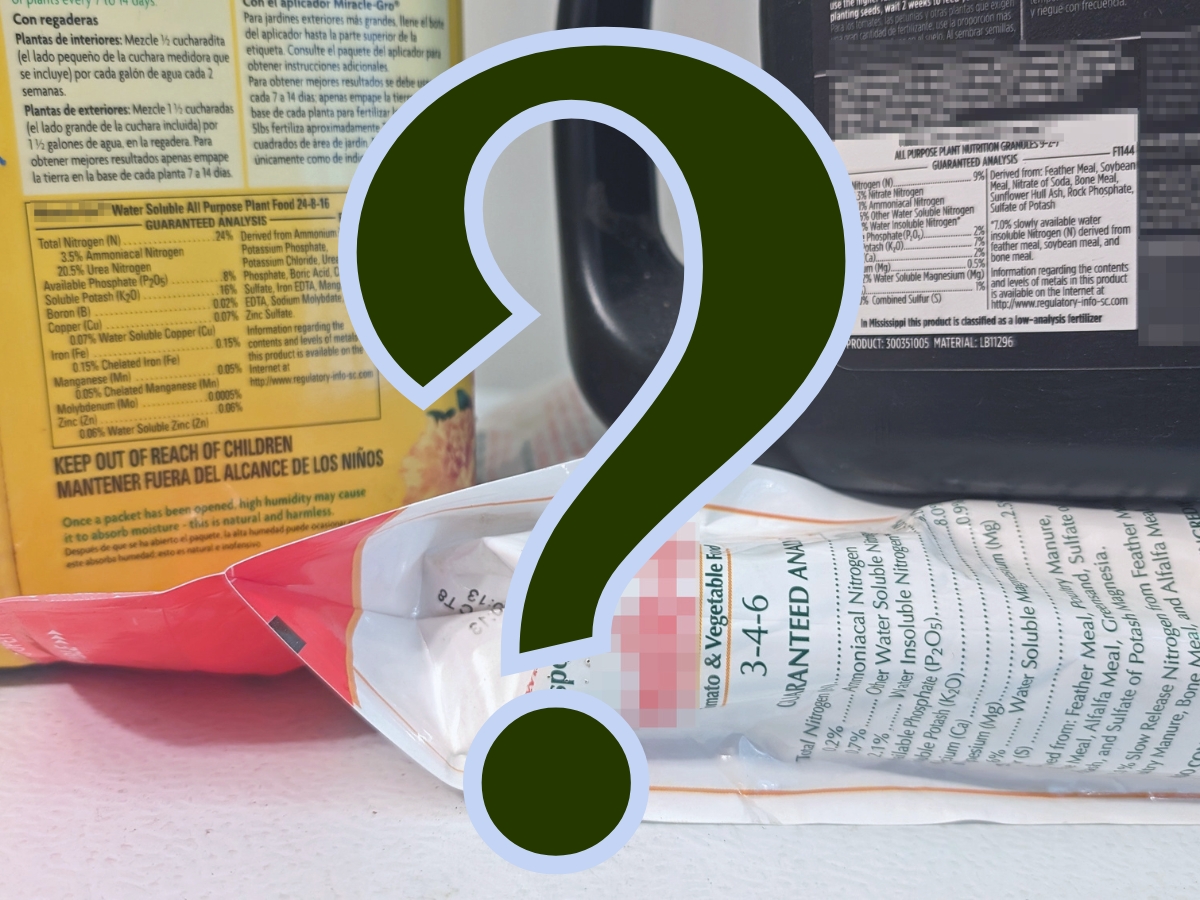

Whether you’re setting your plant plots up for the spring, giving your plants a little love in the middle of the growing cycle, or putting your garden to bed for the winter, you’re going to want to know how to fertilize your garden. With all the commercial fertilizers out there in the world, it can be confusing to know what’s best for your garden. What’s worse, fertilizer labels appear to be written in some unintelligible code or foreign language. How can you know what you’re sprinkling or pouring in your garden if you can’t read the label?! Fear not! This article will help you take the first step to decoding fertilizer labels. No Rosetta stone required.
As a brief fore-warning, this article leans a little toward the mathematics side of life. As a data analyst by day, I find this fascinating, but I know it’s not everyone’s cup of tea. Don’t worry, this article won’t stray beyond 5th grade algebra! I promise!
Soil Testing: What Does Your Garden Need?
The first thing you should ask yourself before delving into the confusing world of commercial fertilizers is what your garden needs. That way you know what you’re looking for before you’re standing in a store reading bewildering fertilizer labels.
Testing your soil is a great way to know exactly what your plants crave (hint: it’s not electrolytes). There’s a variety of ways that you can go about testing your soil. You can test at home with test kits from your local hardware store or nursery. Or you can enlist a local company to test your soil at a cost. Professionally testing your soil tends to be on the expensive side. So, if you don’t really need to know all the details of your soil, using a home test kit is usually sufficient.
Sometimes, all you need to know about your soil is what kinds of plants have been growing there over the past few years. For instance, peas fix nitrogen to the soil, lettuce loves phosphorus, and tomatoes take up a lot of potassium. Corn is a real nutrient-consumer and takes everything out of the soil.

Curious about your soil’s Ph balance? There are a variety of soil meters on the market that can help to determine if your soil is acidic or alkali. But your landscape can help you out too. If you have trees, they can tell a tale. Evergreens tend to make the soil acidic, while many deciduous trees grow happily in balanced or alkali soils. There are exceptions to every rule, of course, so do some research and you’ll have a fair idea what you’re dealing with.
Know what you have, then fertilize for what you don’t to bring your soil into balance.
Fertilizer Labels By the Numbers
The key to a healthy garden is a balanced amount of macronutrients. Macronutrients are nutrients that are required to produce energy, maintain biological structures, and keep natural systems working efficiently. These macronutrients come from a variety of sources and augment garden soil according to its ingredients.
Fertilizers tend to focus on 3 primary macronutrients:
- nitrogen,
- phosphorus, and
- potassium.
It’s these 3 macronutrients that make up the first part of a fertilizer’s label. Together, these 3 primary macronutrients are known as NPK. The letters correspond to their symbols on the periodic table of elements.

Fertilizer labels display their NPK variable prominently, and always in the same order (nitrogen phosphorus, potassium). This way, a gardener can quickly ascertain the kind of fertilizer they’re looking at with a single glance. Sometimes the NPK variable is on the front label of the fertilizer, sometimes it’s on the back or side. Regardless of where various fertilizer companies place the NPK variable, it will always be somewhere on the label.
Why Nitrogen, Phosphorus, & Potassium?
Fertilizer companies call out nitrogen, phosphorus, and potassium specifically on their labels because of the significance of these macronutrients to plants. Each is pivotal to a plant’s growth and overall health. Nitrogen helps plants produce green leaves and stems. Phosphorus promotes healthy roots and helps the plant take in nutrients. Potassium safeguards the plant from extreme heat or cold and facilitates repairs when the plant is damaged.
Macronutrient Percentages
Fertilizer labels show the NPK variable as 3 sequential numbers. These 3 numbers may be separated by a dash, a slash, or just a space, but the order remains the same.
A fertilizer that shows the numbers 10-10-10 on its label is made up of 10% nitrogen, 10% phosphorus, 10% potassium, and 70% of other macronutrients, salts, metals, or other substances.

Fertilizers don’t always contain balanced ratios of nitrogen, phosphorus, and potassium. After all, you won’t always have balanced soil in your garden. So sometimes you need a fertilizer that will replenish the specific macronutrient that your plants have consumed while growing and producing. It’s helpful to know what concentration of macronutrients a fertilizer contains. Here, too, the fertilizer label and NPK variable can help you.
If a fertilizer label shows an NPK variable of 20-10-10, that means it contains twice as much nitrogen than either phosphorus or potassium and only 60% of other substances. This is helpful if you’ve just finished harvesting brassicas like kale in your garden, which really eat up the nitrogen from the soil.
A Helpful Chart for Fertilizer Labels
Here’s a helpful chart that makes it easy to see what different NPK variables look like.

Let’s look at a real life example.
The label pictured below is from a 2.5 pound container of fertilizer. The label says the fertilizer has an NPK variable of 9-2-7. This means that the fertilizer contains
- 9% nitrogen,
- only 2% phosphorus, and
- 7% potassium.

Basic algebra tells us that means this fertilizer package contains
- 0.225 lb. nitrogen,
- 0.05 lb. phosphorous, and
- 0.175 lb. of potassium.
Therefore, in this fertilizer, less than half a pound (0.45 lb.) is made up of the 3 primary macronutrients plants need to grow and thrive. Not a lot!
So, wait, what’s the other 2.05 lbs. made up of, then? What are we paying for, anyway?! Well, read on.
How to Know What Else is in Fertilizer by Looking at the Label
In common fertilizers, there’s a lot of ‘other’ content that isn’t the 3 primary macronutrients. What is it?! The only real way to find out is to do what you do at the grocery store for your own food: read the ingredients. After all, this is your plants’ food we’re talking about!

Most fertilizer companies will add additional details about what else they’ve included on the label. These ingredients are usually beneath the spelled out NPK value on the back or side of the package or container. Common other ingredients include:
- Calcium (Ca)
- Magnesium (Mg)
- Sulfur (S)
- Iron (Fe)
- Boron (B)
- Copper (Cu)
- Zinc (Zn)
Unless you’re buying a specialty fertiliizer, chances are that the full sum of the ingredients listed on the label won’t add up to 100% of the fertilizer. This is because each company has its own proprietary mixture that it doesn’t want to disclose to its competitors. It is a business, after all.
If the label identifies at least 25% of the ingredients in your fertilizer, it’s probably a pretty good fertilizer.
Fertilizer Labels Demystified!
Whew! Who ever thought labels could be so confusing? Especially fertilizer labels! I hope this helps uncomplicate a topic that really shouldn’t be so complicated. At the very least, you’ll know what kind of food you’re buying for your plants. And knowing what your plants are eating is a key step to knowing what you’re eating when you bring your produce to the table!



One response to “Nourish to Flourish: A Gardener’s Guide to Fertilizer Labels”
[…] Fertilizer and light plays a role in tomato ripening as well, but this reason is more common in greenhouses. Tomatoes outdoors generally have the right environment in the open air. However, if you’re growing your tomatoes in containers, then you may wish to given them a little extra fertilizer in the late summer to early autumn season. This will ensure they have the right nutrients to speed their tomatoes to harvest-ready. [Learn how to read fertilizer labels to make sure your tomatoes are getting what they need.] […]